USS Arizona (BB-39)
Before she became a memorial, Arizona had spent twenty-five years as a working battleship.
USS Arizona is now so closely associated with the memorial at Pearl Harbor that the ship which lies beneath it can sometimes recede from view. Yet the wreck represents the end of a naval career which began a quarter of a century earlier, when Arizona entered service as one of the United States Navy's newest dreadnought battleships.
During those twenty-five years she crossed the Atlantic and Pacific, served repeatedly as a flagship, represented the United States overseas, carried a president, took part in the Navy's large inter-war Fleet Problems and underwent a reconstruction extensive enough to change both her appearance and her capabilities.1
The surviving wreck is therefore more than the physical record of a single morning in December 1941. It is also the remains of that longer-lived ship.
A new American battleship
The second ship of the United States Navy to carry the name Arizona was laid down at the New York Navy Yard on 16 March 1914. She was launched on 19 June 1915 and commissioned on 17 October 1916 under Captain John D. McDonald. 1
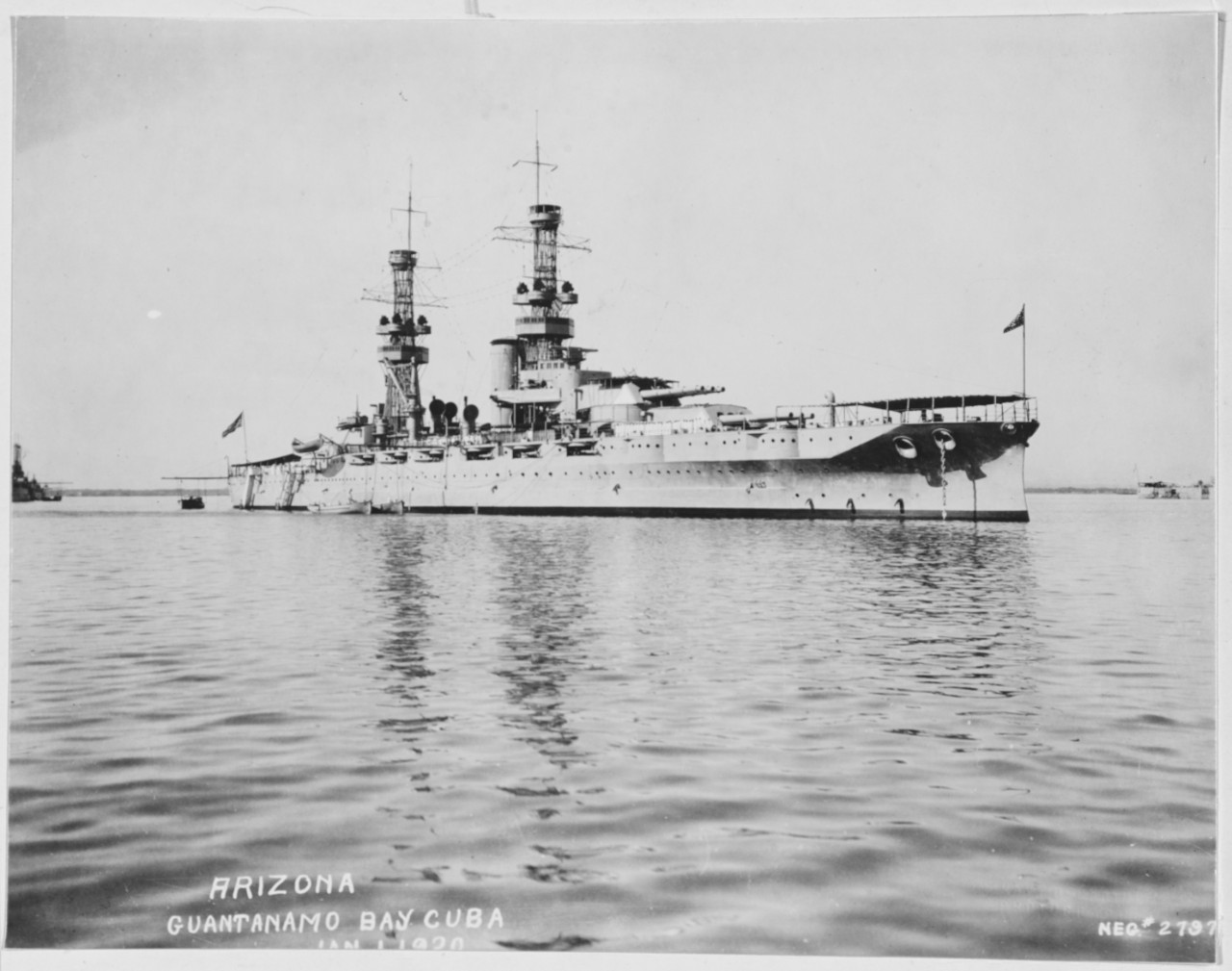
She was the second of the two Pennsylvania-class battleships, built at a point when the major naval powers were still refining the form of the dreadnought. Her principal battery consisted of twelve 14-inch guns mounted in four triple turrets, all arranged on the centreline. Two turrets stood forward and two aft.
The arrangement concentrated considerable firepower into a comparatively compact layout. It also produced the broad, heavily armoured hull that remained recognisable through the many alterations made during the ship's service life.
A First World War battleship that stayed home
Arizona had completed little more than her initial training when the United States entered the First World War in April 1917. Unlike several American battleships which later operated with the British Grand Fleet, she remained in American waters.
The reason was practical. Arizona burned fuel oil, which was in short supply in Britain, while the American battleships deployed to European waters could make use of British coal supplies. She consequently spent much of the war operating from Norfolk, training gun crews and patrolling the eastern seaboard.1
Her first European deployment followed the Armistice. In November 1918 she sailed to Britain and subsequently joined the escort for the liner George Washington, carrying President Woodrow Wilson towards the Paris Peace Conference. On the return voyage Arizona carried 238 American servicemen home from France, reaching New York on Christmas Day.1
Smyrna and Constantinople
In 1919 the battleship returned to Europe and continued into the eastern Mediterranean. At Smyrna, modern İzmir, Arizona was present during the instability which accompanied the Greek occupation of the city.
The ship provided temporary refuge aboard for civilians while her Marine detachment guarded the American consulate. She later carried the United States consul-at-large to Constantinople before returning to New York in June. 1
It was a relatively brief episode in the ship's career, but a useful indication of the work performed by a major warship in peacetime. Battleships were instruments of diplomacy and presence as much as platforms for fleet combat.
To the Pacific
In January 1921 Arizona passed through the Panama Canal for the first time. During that year she visited Peru twice, including service as flagship during ceremonies marking the centenary of Peruvian independence. 1
In August she arrived at San Diego. For much of the following fourteen years she was based at San Pedro, alternately serving as flagship of several battleship divisions and operating with the fleet off California, in the Caribbean, around Panama and between the west coast and Hawaii. 1
Much of this period was occupied by the annual Fleet Problems. These exercises tested the fleet on a scale which normal training could not: long-distance operations, attacks on defended bases, reconnaissance, amphibious operations and encounters between opposing battle fleets.
Seen from the perspective of 1941, these exercises can easily acquire a retrospective significance. At the time they were simply part of the working life of the fleet, repeated year after year as the Navy tried to understand how its ships, aircraft and communications would function across the distances of the Pacific.
Rebuilding Arizona
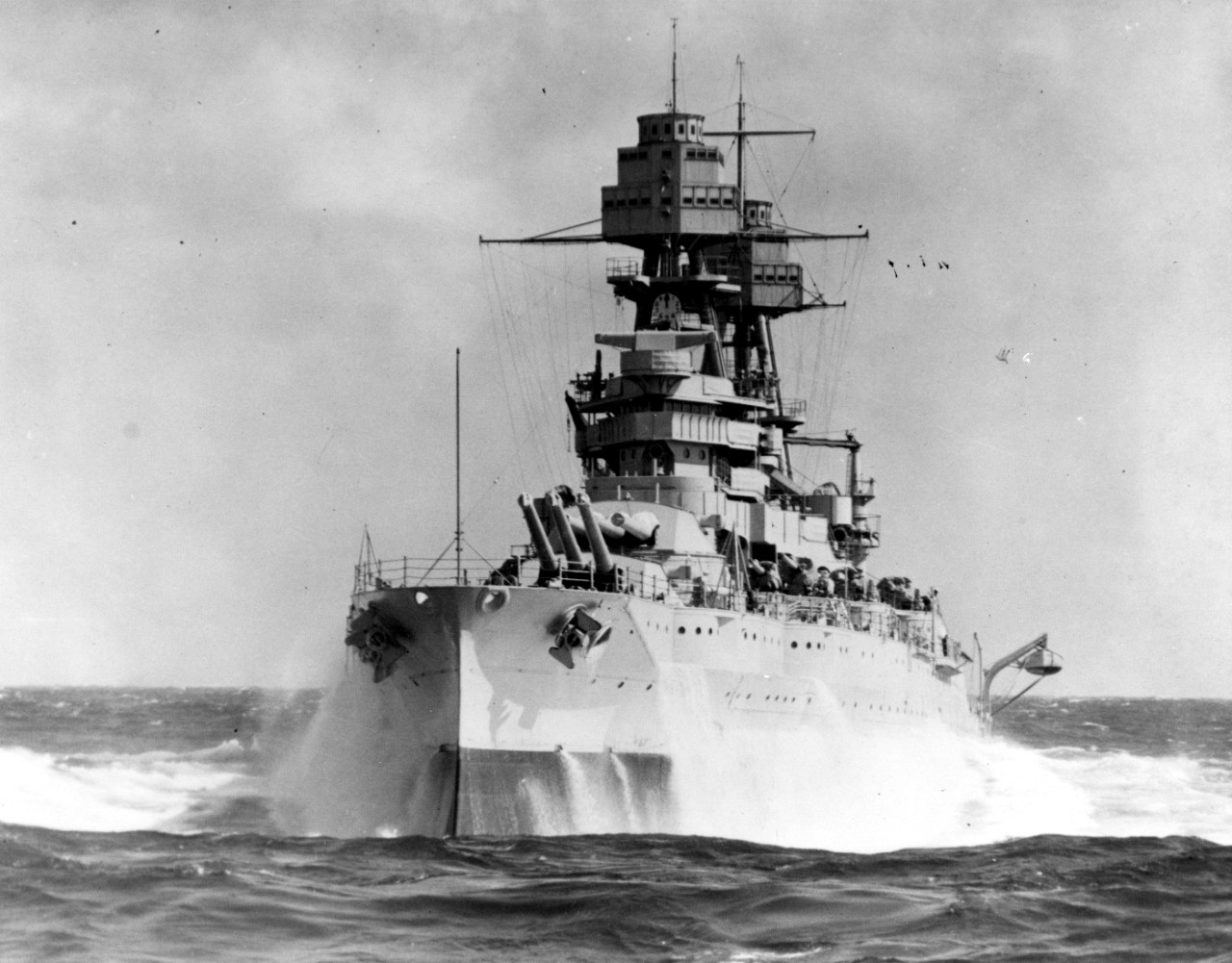
By the end of the 1920s, Arizona's original appearance already belonged to an earlier generation of battleship design. In May 1929 she entered Norfolk Navy Yard for a reconstruction which would keep her out of normal service for almost two years. 1
The familiar lattice or cage masts were removed and replaced by substantial tripod structures carrying new fire-control positions. Additional armour was fitted, anti-torpedo bulges widened the hull, her anti-aircraft armament was revised, and the machinery was extensively renewed with new boilers and new main and cruising turbines.1
She returned to full commission on 1 March 1931. The result was still recognisably the same hull launched in 1915, but with a very different silhouette and a substantially altered internal arrangement.
A presidential voyage
Only a few weeks after returning to commission, Arizona took on a role far removed from battle practice. President Herbert Hoover embarked at Hampton Roads on 19 March 1931 for a voyage to Puerto Rico and the Virgin Islands. The battleship returned ten days later before continuing with her post-reconstruction trials. 1
By August she was back with the Pacific Fleet. Exercises, gunnery practice, maintenance periods and divisional flagship duties occupied much of the remaining decade.
The final years of a working ship
The Pacific Fleet increasingly operated from Hawaii during 1940 and 1941, and Pearl Harbor became Arizona's principal base. Despite worsening international relations, the routine aboard remained recognisably naval: exercises, maintenance, inspections and gunnery.
Only a few days before her loss, Arizona was still carrying out night firing exercises with other battleships. There is no useful way to separate the ship of December 1941 from the events which followed, but neither did those events define the previous twenty-five years of her existence.
7 December 1941
During the attack on Pearl Harbor, Arizona was moored at berth F-7 beside Ford Island. She was struck repeatedly by bombs. One armour-piercing bomb penetrated the ship forward and caused the catastrophic detonation of the forward magazines. The explosion destroyed much of the forward part of the vessel and the resulting fire continued for two days. 3
The scale of the loss was profound. This page does not attempt to retell the attack in detail; numerous specialist histories and memorial resources already do that work. For understanding the wreck, the important point is that the forward hull suffered catastrophic structural damage while substantial portions of the ship remained submerged around their berth.
Salvage
Divers were examining the submerged ship within a week. The work which followed was extensive. Ordnance, hazardous materials and portions of the superstructure were removed, as were the main gun turrets and their 14-inch guns. 3
This work substantially changed the appearance of the wreck. The Arizona visible today is therefore not simply the battleship as she settled in December 1941. It records the explosion, fire, structural collapse and a prolonged programme of wartime salvage.
Some of the removed armament subsequently returned to service. Three 14-inch guns originally associated with Arizona's second turret were installed aboard USS Nevada. They later fired during bombardment operations at Iwo Jima and Okinawa. Other guns from the ship were adapted for coastal defence on Oahu. 4
The battleship herself was not raised.
The wreck beneath the memorial
The surviving hull remains alongside Ford Island, much of it below the surface and beneath the memorial constructed across the ship. Large sections of the lower hull survive, while the forward area records the destructive effects of the magazine explosion and the upperworks were substantially altered by subsequent salvage.
For that reason the wreck should not be read as a complete battleship preserved on the seabed. It is an archaeological site formed by several distinct processes: the construction and repeated modification of the original ship, its destruction, salvage, structural deterioration and more than eight decades of immersion.
The three-dimensional survey is particularly useful in making that distinction clear. A familiar overhead photograph of the memorial reveals relatively little of the size of the surviving hull. Once the measured wreck is viewed independently and rotated, the dimensions of the battleship and the distribution of the surviving structure are considerably easier to understand.
USS Arizona is both a historic shipwreck and the resting place of members of her crew. The 3D model below is presented to help understand the surviving ship and the archaeological site. It is not intended to recreate or dramatise the circumstances of their deaths.
Explore USS Arizona in 3D
The model below is derived from measured survey data of the surviving wreck. Drag to rotate, scroll to zoom and right-drag to move across the site. No missing portions of the battleship have been reconstructed.
3D survey data
The model used here is derived from the USS Arizona multibeam-sonar dataset published through Open Heritage 3D.
Dataset DOI: 10.34946/D6N30Q. The Open Heritage record credits the US National Park Service Submerged Resources Center, Autodesk and R2Sonic.
The web model has been reduced from the source survey for browser display. Point density, gaps and surface appearance should therefore not be interpreted as a complete record of every surviving structural feature.
From wreck to memorial
In 1950 Admiral Arthur W. Radford, then Commander-in-Chief of the Pacific Fleet, ordered that the national colours again be raised over the wreck. Further recognition followed, and the present USS Arizona Memorial was dedicated in May 1962.3
The ship today occupies several roles at once. She is an archaeological site, a surviving American battleship, a national memorial and the resting place of members of her crew. Those roles understandably dominate the way Arizona is encountered today.
They need not erase the history of the vessel which preceded them. The hull beneath the memorial was launched in 1915 and spent twenty-five years being worked, altered, maintained and sailed. It crossed oceans, carried sailors through long periods of ordinary service, represented the United States abroad and was rebuilt as naval technology changed around it.
Looking at the surviving wreck in three dimensions offers a different way of approaching Arizona: not simply as the location of a historic event, but as the remains of the ship herself.
Sources and further reading
- Vincent James "Jim" Vlach Jr., “USS Arizona (BB-39) History”, USSArizona.org. Detailed chronology of the ship from construction through her First World War service, overseas deployments, Pacific Fleet career and 1929–31 reconstruction.
- Naval History and Heritage Command, USS Arizona (BB-39) photographic collection. Historic imagery documenting the battleship throughout her career and after reconstruction.
- Defense POW/MIA Accounting Agency, “History and Recovery Efforts of the USS Arizona (BB-39)”. Used principally for the circumstances of the ship's loss, immediate survey and salvage, treatment of remains and development of the memorial.
- The National WWII Museum, “The USS Arizona's Last Salvo”. Used for the later history of guns removed from Arizona, including their subsequent wartime use.
- Open Heritage 3D, USS Arizona, Pearl Harbor — D6N30Q. Source record for the three-dimensional survey visualised on this page.