U-625: The Sinking in Four Photographs
On 10 March 1944 a Canadian Sunderland attacked a German U-boat in the North Atlantic. Its crew photographed what followed: the attack, the crippled submarine, its abandonment and the men left behind in the Atlantic.
Most wartime shipwrecks are known through fragments: a position in a loss record, a survivor's account, perhaps a photograph of the vessel before she disappeared. The loss of U-625 is different. On 10 March 1944 her destruction was recorded from the aircraft attacking her, producing an extraordinary sequence of photographs which follows the U-boat from the initial depth-charge attack to her abandonment and sinking, and finally to her surviving crew gathered in inflatable dinghies on the open Atlantic.
The photographs were taken from Short Sunderland Mark III EK591 'U' of No. 422 Squadron, Royal Canadian Air Force, during and after its attack on U-625 approximately 500 miles west of Land's End. Preserved by the Imperial War Museums, the sequence records events with unusual continuity: six depth charges straddling the stern, the explosions around the submarine, U-625 sinking by the stern around an hour and a half later, and the men who had escaped her bringing their dinghies together for support. None of those men survived.
U-625
U-625 was one of the hundreds of Type VIIC submarines which formed the core of the German U-boat force during the Second World War. She was ordered in August 1940, laid down at the Blohm & Voss yard in Hamburg on 28 July 1941, launched on 15 April 1942 and commissioned on 4 June under Kapitänleutnant Hans Benker.1
After training with the 8th U-boat Flotilla, U-625 entered active service in October 1942. Her career took her through the 3rd, 11th, 13th and finally the 1st U-boat Flotillas. Across ten patrols she was credited with sinking three merchant ships totalling 18,751 gross register tons and two auxiliary warships totalling 1,129 tons.1
Much of her earlier operational career had been spent in northern waters. Among her victims were the merchant ships Chulmleigh, Empire Sky and Goolistan, lost during operations around the Arctic convoy routes in November 1942.1
A change of command
U-625's final months were already marked by loss before the events photographed in March. On 2 January 1944, during an encounter with a British Liberator aircraft in the Bay of Biscay, the submarine began to dive. Commander Hans Benker and another member of the crew were still outside the pressure hull and were lost when the boat continued beneath the surface.1
Oberleutnant zur See Siegfried Straub assumed command later that month. On 29 February 1944 he took U-625 out of Brest on what would become her tenth and final patrol.1
10 March 1944
On 10 March U-625 was operating far out in the North Atlantic. The recorded position of her loss is approximately 52°53′N, 20°19′W, around 500 miles west of Land's End. There she was found on the surface by a Short Sunderland Mark III of No. 422 Squadron RCAF.1
The aircraft was EK591, coded 'U'. The Sunderland was a large four-engined flying boat designed for long maritime patrols. By 1944 aircraft of RAF Coastal Command and its Commonwealth squadrons had become one of the principal threats to U-boats travelling on the surface. Their endurance allowed them to patrol enormous areas of the Atlantic, while depth charges and machine guns gave them the means to attack a submarine before it could escape beneath the surface.
What makes this particular encounter exceptional is that the attack and its aftermath were photographed. The surviving sequence is now held by the Imperial War Museums and follows the destruction of U-625 from the first depth charges to the fate of the men who abandoned her.2
The following photographs are Imperial War Museums C 4287, C 4289, C 4292 and C 4293. The descriptions of the attack below are based primarily on the IWM catalogue records for the original photographs.
1. The attack
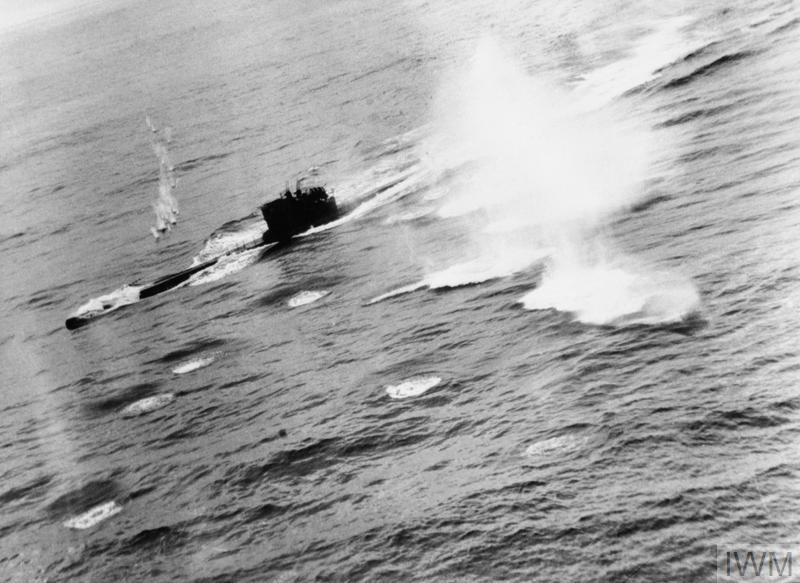
The first photograph catches the attack before the depth charges have detonated. Six charges dropped by EK591 are entering the water across the stern of U-625. Beyond the bows, smaller splashes mark the first burst of machine-gun fire from the Sunderland's rear gunner.2
It is an unusual photograph because the individual elements of the attack can still be distinguished. U-625 remains underway on the surface, the depth charges have entered the sea but have not yet exploded, and the gunfire is falling beyond the submarine. Within moments the scene had changed completely.
2. The depth charges explode
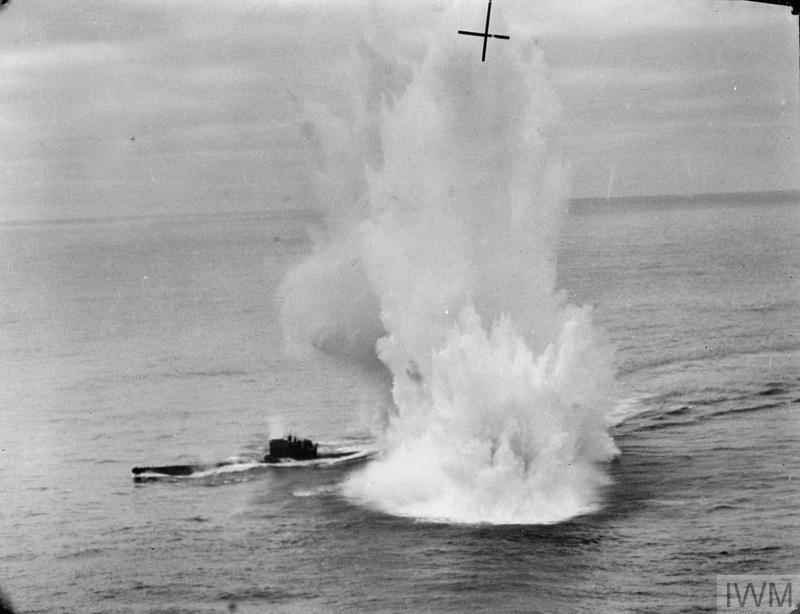
The second photograph records the detonation. The depth charges are exploding around U-625's stern, throwing great columns of water above the submarine, while machine-gun fire from the Sunderland's rear gunner straddles the bows and conning tower.2
U-625 submerged shortly afterwards. It was not an escape. Three minutes later she returned to the surface in a damaged condition.2 The Sunderland remained overhead while the crew attempted to save their boat.
3. Abandoning U-625
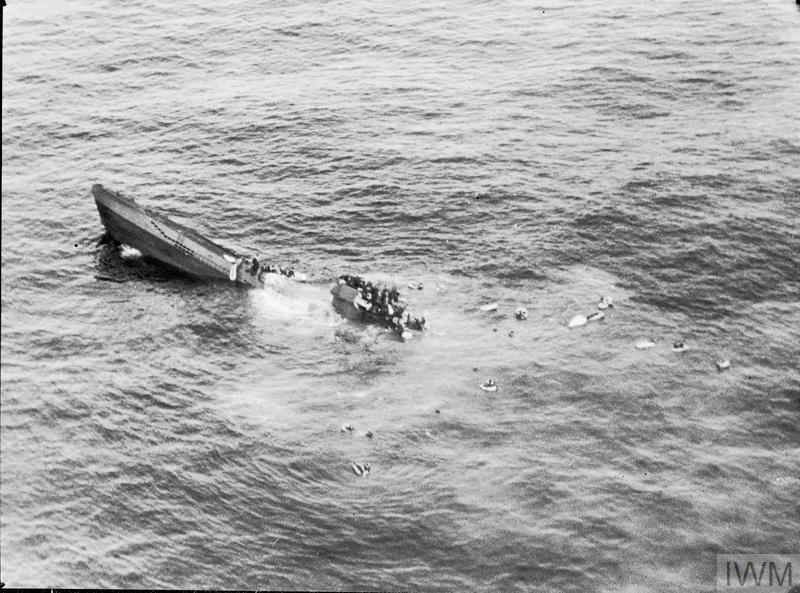
Approximately an hour and a half after the attack, U-625 could no longer be saved. The third photograph shows the crew taking to their dinghies while the submarine sinks beneath them by the stern. Men can be seen clustered around the remaining exposed hull and in the water alongside it.2
The interval is important. U-625 was not destroyed instantaneously by the explosions photographed in the previous frame. She survived the initial attack, submerged, resurfaced damaged three minutes later and remained afloat for roughly another ninety minutes before finally sinking.
4. The survivors
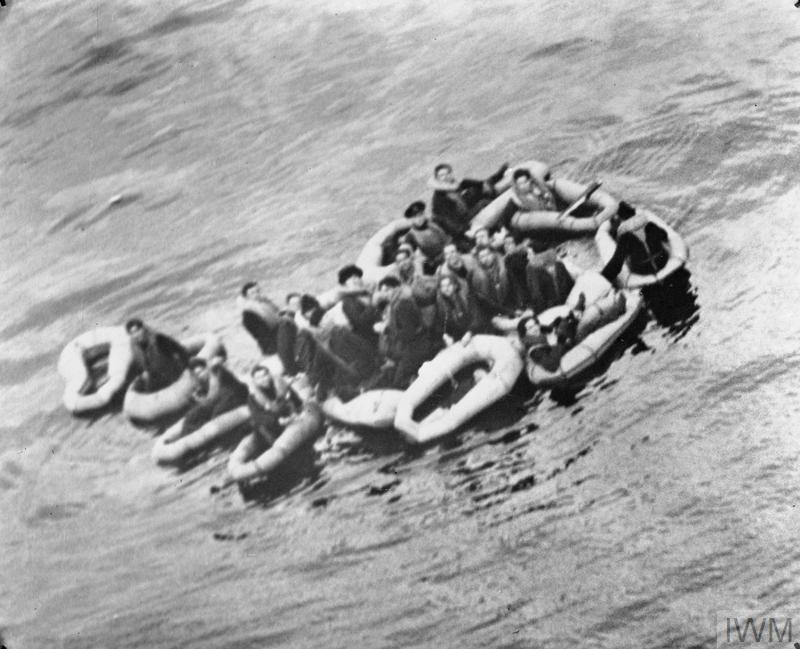
The final photograph is very different. U-625 has disappeared beneath the Atlantic and the surviving members of her crew are bringing their inflatable dinghies together for support. They were approximately 500 miles west of Land's End, far from immediate assistance.2
There is something deceptive about the image when seen without its context. The attack is over, the submarine has gone, and the men appear to have successfully escaped into their survival equipment. It would be easy to read it as the end of the incident. It was not. The Imperial War Museums catalogue records simply that none of them survived their ordeal.2
All 53 men aboard U-625 were lost.1 The photograph is therefore the last surviving record of men who had escaped the destruction of their submarine but were still hundreds of miles out in the North Atlantic.
The aircraft above them
No. 422 Squadron was a Royal Canadian Air Force general reconnaissance squadron operating as part of RAF Coastal Command. Its Sunderland flying boats carried out anti-submarine and convoy-support patrols over the Western Approaches and the wider Atlantic.3
EK591 was a Short Sunderland Mark III. Its size and endurance made the Sunderland particularly well suited to distant maritime patrols. It could search huge areas of ocean and, once contact had been made, remain above a submarine after an initial attack.
The photographs of U-625 demonstrate another part of the aircraft's role. They were not taken from a ship arriving after the event, nor reconstructed later from eyewitness testimony. They were made from the aircraft which carried out the attack while the events themselves were unfolding.
Four photographs
There is a tendency for photographs of wartime destruction to become detached from one another. One image appears in a book, another in an archive or on a website, until each becomes simply an illustration of a U-boat under attack. Seen together, the U-625 photographs are something different.
C 4287 shows a functioning submarine under attack. C 4289 records the violence of the depth-charge explosions. By C 4292 the boat is sinking and its crew are trying to escape. C 4293 contains no submarine at all: only the men who had been aboard it.
The sequence compresses roughly an hour and a half into four frames. It also records a transition that is normally invisible in the archaeological record. A wreck survey begins with the ship already on the seabed. Here, unusually, the camera shows the process by which the wreck was created.
Vessel: German submarine U-625
Type: Type VIIC
Builder: Blohm & Voss, Hamburg
Werk number: 601
Commissioned: 4 June 1942
Final commander: Oberleutnant zur See Siegfried Straub
Date lost: 10 March 1944
Recorded position: approximately 52°53′N, 20°19′W
Location: approximately 500 miles west of Land's End
Cause: Depth-charge attack by Short Sunderland Mark III EK591 'U', No. 422 Squadron RCAF
Complement lost: 53
The wreck
U-625 was lost in the open North Atlantic at approximately 52°53′N, 20°19′W, around 500 miles west of Land's End. This places the wreck far beyond the high-resolution coastal bathymetric surveys normally featured on Wrecksite. There is therefore no surveyed wreck model to present here and no useful reason to provide the usual link to the interactive map.
In this case the record above the surface is more revealing. The condition of U-625 on the seabed may remain unseen, but the surviving photographs document the moments in which she became a wreck with an immediacy that seabed survey data cannot reproduce.
Sources
- Imperial War Museums, photographic record of the attack on and sinking of U-625, 10 March 1944: C 4287, C 4289, C 4292 and C 4293.
- uboat.net, The Type VIIC U-boat U-625. https://uboat.net/boats/u625.htm
- uboat.net, The Royal Canadian Air Force (RCAF) – Aircraft – Fighting the U-boats . https://uboat.net/allies/aircraft/rcaf.htm