SS Polwell
Built in Britain, sold into German ownership, captured by Britain and finally sunk by a German U-boat.
Of all the ways a merchant ship could find itself on the wrong side of a war, Polwell managed an unusually complicated route.
She had been built in Britain, later became a German merchant ship, was captured by the British after the outbreak of the First World War and returned to service carrying coal for the Allies.
In June 1918, after almost thirty years at sea and several changes of identity, the story came full circle. Polwell was intercepted off the north Dublin coast by the German submarine U-96.
Northumbria
The ship which eventually became SS Polwell began life in Sunderland in 1888.
Built by J. L. Thompson & Sons, she was originally named Northumbria. She was a steam cargo vessel powered by a triple-expansion engine and measured approximately 86.6 metres from bow to stern.
Like many merchant steamers of the period, there was little glamorous about her purpose. Ships such as Northumbria existed to move large quantities of cargo reliably between ports, and she spent the next two decades doing exactly that.
Then her nationality changed.
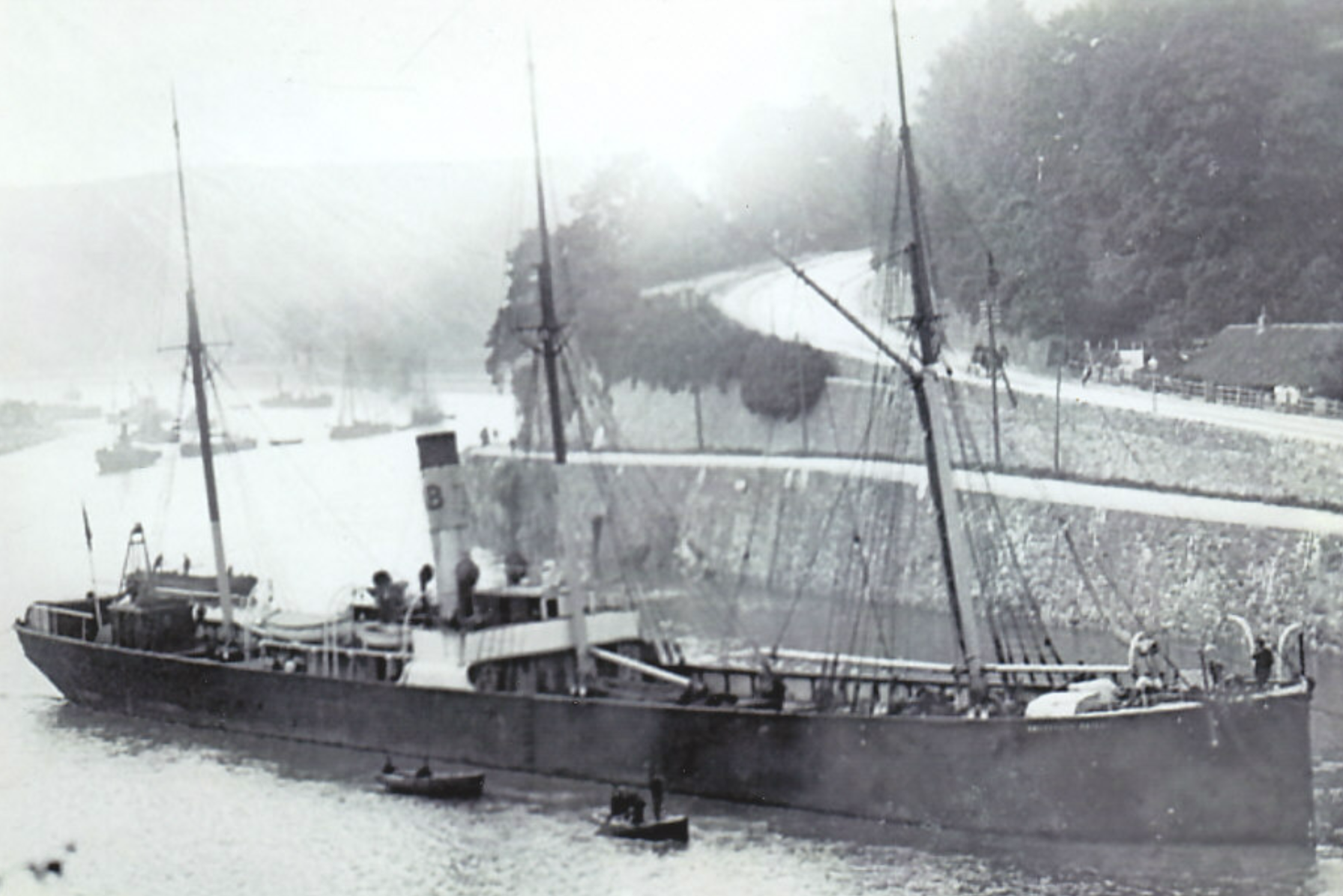
A German merchant ship
Before the First World War, the vessel passed into German ownership and eventually took the name Syra, registered at Hamburg.
That would normally have been little more than another chapter in the career of an ageing tramp steamer. The outbreak of war in 1914 changed matters rather dramatically.
Syra was captured by the British near Gibraltar. What had become an enemy merchant vessel was requisitioned and returned to service under British control.
She was eventually renamed Polwell.
By the later years of the war she was operating as a defensively armed steam collier, managed by the Clyde Shipping Company of Glasgow.
A ship built on the Wear, sold abroad and flying the German flag was now carrying cargo in support of Britain's war effort.
5 June 1918
On 5 June 1918, Polwell was sailing from Troon in Scotland towards France with a cargo of coal intended for the Allied war effort.
Off the north Dublin coast she encountered U-96.
The submarine first fired a warning shot across Polwell's bow. There was, unusually for a First World War shipwreck story, time for the crew to react.
All thirty men aboard abandoned ship in two lifeboats.
Only after they had left did U-96 fire a torpedo.
It struck Polwell amidships.
The ship sank quickly, ending an almost thirty-year career around six miles from Rockabill and north-east of Lambay Island.
The entire crew survived.
About an hour later they reached Rockabill lighthouse.
A strangely circular war
There is something particularly odd about Polwell's loss.
She was not simply another British merchant ship sunk during the submarine campaign.
She had begun life in Britain, spent part of her career under the German flag, been captured by Britain because she was German-owned, and then returned to sea as part of the Allied merchant fleet.
Four years later Germany sank her.
The sequence is a useful reminder of how international merchant shipping had become before 1914. Ships could change owners, registries and names repeatedly during their working lives. The neat national divisions imposed by war did not necessarily match the much messier histories of the vessels themselves.
The wreck today
Polwell lies in roughly 30 to 36 metres of water off the north Dublin coast. Modern surveys place the wreck approximately north-east to south-west, with the bow towards the north-east.
The surviving wreck footprint is around 92 metres long — slightly greater than the original hull dimensions — as collapsed structure and separated sections have spread across the seabed.
Polwell is now broken into three principal sections, although remarkably large areas of the vessel remain recognisable. The superstructure is gradually collapsing and the bow has become separated from the main body of the wreck.
The wreck therefore captures two processes at once.
There is the sudden destruction caused by the torpedo in 1918, followed by more than a century of much slower change as steel corrodes, structure collapses and the seabed moves around it.
Mapping Polwell
That process has made Polwell particularly valuable to marine archaeologists and hydrographers.
In 2015, the Marine Institute and Ulster University carried out an exceptionally detailed multibeam survey of the wreck from the research vessel Celtic Voyager.
Rather than simply confirming that a wreck existed at the charted position, the survey generated millions of individual soundings across the remains, producing an extremely dense three-dimensional model of the site.
The resulting data revealed details of the deck, surviving superstructure and the three sections into which the wreck has broken.
Polwell has since become something of a test subject for seabed mapping itself. Researchers have repeatedly surveyed and modelled the wreck to investigate how different sonar settings affect wreck imagery, how sediment moves around large objects on the seabed, and how historic wreck sites physically change through time.
It is an unexpected final career for an ordinary cargo steamer.
Northumbria carried cargo. Syra became an enemy ship. Polwell carried coal for the Allies.
And a century after U-96 sank her, the same ship is now helping us understand how to see beneath the sea.
Survey and further reading
SS Polwell has been surveyed in detail by the Marine Institute, INFOMAR and Ulster University. The site has subsequently been used in research into high-resolution multibeam mapping, shipwreck preservation and sediment movement around underwater archaeological sites.
Explore the wreck
Open SS Polwell directly on the Ireland wreck map and explore the surrounding seabed.
Zoom to SS Polwell