SS Oceana
A P&O liner, a collision off Beachy Head and £747,110 in gold and silver beneath the Channel.
Around four nautical miles from Beachy Head lies the wreck of SS Oceana, a large P&O liner lost in March 1912 after colliding with the German four-masted barque Pisagua. The sinking was notable not only for the circumstances of the collision and the loss of life during the evacuation, but for the cargo that went down with the ship: gold and silver bullion valued at £747,110. Divers were inside the wreck recovering it within days. 1 2
A Jubilee liner
Oceana was built at Belfast by Harland & Wolff as yard number 201. She was launched on 17 September 1887 and completed in February 1888 for the Peninsular & Oriental Steam Navigation Company. At 6,610 gross register tons and approximately 142.8 metres long, she was one of the substantial new generation of liners entering P&O service during the closing decades of the nineteenth century. 1 3
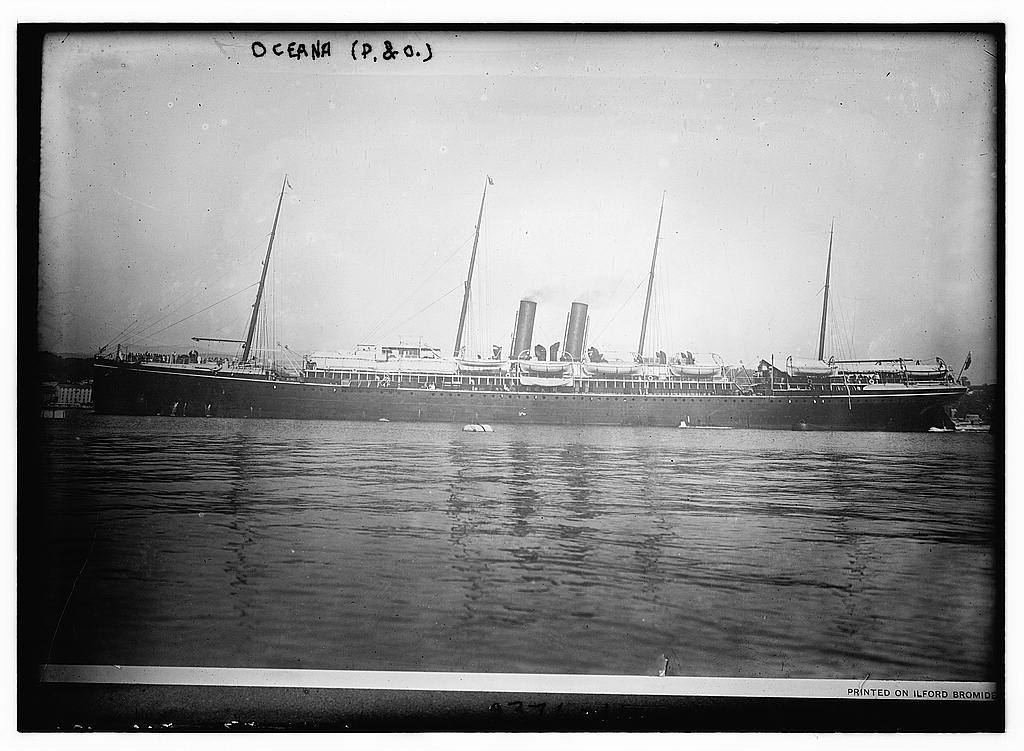
She belonged to P&O's Jubilee class, introduced during the period of the company's fiftieth anniversary and Queen Victoria's Golden Jubilee. Her single screw was driven by a three-cylinder triple-expansion steam engine developing about 7,000 indicated horsepower, giving a service speed of around 16.5 knots. Passenger accommodation was provided for approximately 250 first-class and 159 second-class passengers. 1 3
Oceana's maiden voyage began on 19 March 1888, taking her from London towards Melbourne and Sydney by way of Colombo. She remained principally associated with P&O's Australian service until 1905, when a refit preceded her transfer to the London–Bombay route. By the time she left Tilbury for the last time in March 1912, she had been in service for almost twenty-four years. 1
One passenger provides an unusually recognisable connection with the ship's earlier career. Mark Twain travelled aboard Oceana from Sydney to Ceylon in 1895 during the journey later described in Following the Equator. His account gives a glimpse of the liner during the ordinary passenger service for which she had been built, long before the circumstances of her loss made her name familiar for very different reasons. 1
The final voyage
At 2pm on 15 March 1912, Oceana left Tilbury bound for Bombay under Captain Thomas H. Hyde RNR. She carried 41 passengers and approximately 220 crew. As was common aboard British liners operating on routes to India and the Far East, a substantial proportion of the crew were lascars. 1 4
Her cargo made the voyage rather less ordinary. Stored aboard the ship were gold and silver ingots valued at £747,110. The contemporary value is striking enough on its own; it also meant that when the ship was lost, recovering her cargo became an immediate priority. 1 2
During the early hours of 16 March, Oceana was steaming westwards through the Strait of Dover. Approaching from the opposite direction was Pisagua, a German four-masted steel barque of about 2,850 tons belonging to F. Laeisz of Hamburg. The sailing ship was returning from Mejillones in Chile with a cargo of nitrate. 1 4
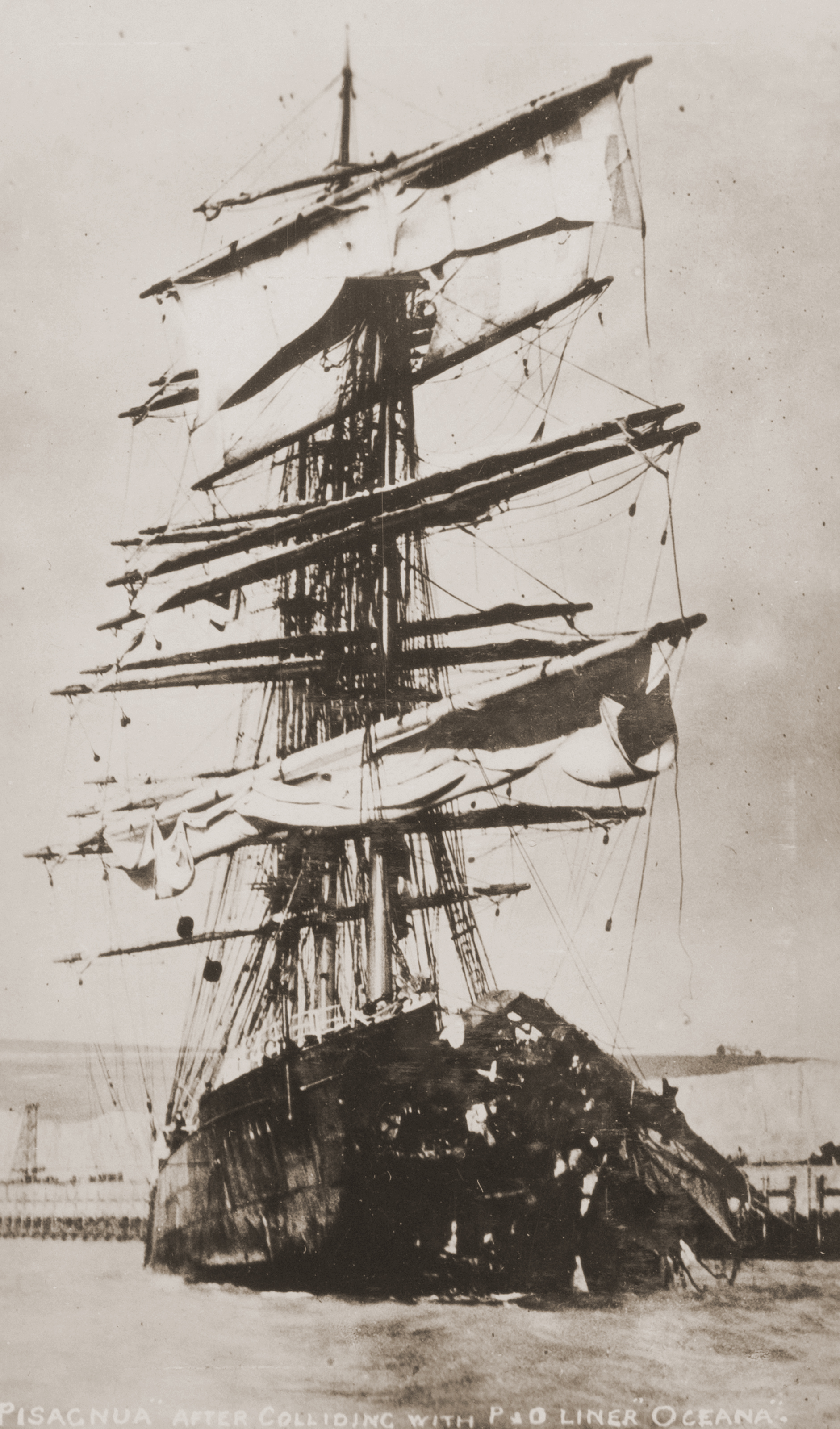
The vessels sighted one another when they were only about half a nautical mile apart. A warning flare was shown from Pisagua. A turn to port was ordered aboard Oceana, followed by hard-a-port when it became clear that the manoeuvre would not take the liner clear. There was insufficient distance remaining. Pisagua's bow struck Oceana amidships, tearing an opening roughly 40 feet, or 12 metres, long in her side. 1 4
The collision occurred approximately four nautical miles off Beachy Head. 2
Abandoning Oceana
The watertight doors were ordered closed and passengers and crew were sent to their boat stations. Oceana transmitted a distress signal, bringing several vessels to her assistance. Among them was the London, Brighton & South Coast Railway ferry Sussex, together with two paddle steamers and the liner Ruahine. 1 4
The principal loss of life did not occur in the collision or when the liner eventually sank. During the evacuation one of Oceana's lifeboats fell while being lowered and capsized. The account published by the Company of Master Mariners of Australia, together with the commonly cited modern history of the ship, records the deaths of seven passengers and ten members of the crew. Published accounts are not completely consistent on the casualty total, however, with some giving a lower figure. 1 3 4
Sussex subsequently took aboard 241 survivors. The liner herself remained afloat, and for several hours there remained a realistic prospect that she might be saved. 1
At about 8am the Newhaven tug Alert began towing Oceana stern-first. Over the following two hours, however, the damaged liner's condition steadily deteriorated. Her list increased until the propeller was being lifted clear of the water. Captain Hyde and the remaining crew eventually abandoned her to Alert. 1 4
Shortly afterwards Oceana rolled further and sank. The water was shallow enough that her masts and the tops of her funnels remained visible above the surface at low tide, immediately making the wreck both a navigational hazard and an unusually accessible salvage target. 1 2
Who was responsible?
The physical circumstances of the collision might suggest a straightforward allocation of responsibility: Pisagua's bow had struck the side of Oceana. The legal position was rather different. Under the navigation rules applying to the two ships, the steamship was required to keep clear of the sailing vessel. 1
P&O subsequently sought damages from the owners of Pisagua, F. Laeisz, but the case went against the company. The official inquiry also found fault aboard Oceana. Her chief officer's certificate was suspended for six months and Captain Hyde was censured. 1
It is one of the more interesting aspects of the loss because the visible mechanics of the accident and the legal responsibility for it point in opposite directions. Although Oceana was the vessel physically struck, it had been her responsibility as the powered vessel to avoid Pisagua.
£747,110 on the seabed
The bullion ensured that Oceana could not simply be left where she had sunk. Salvage arrangements were made almost immediately, and divers began working on the wreck the day after the loss. 1 2
The gold and silver had been secured within strongrooms aboard the liner. Accounts of the salvage describe the divers first entering the captain's cabin and opening his safe to recover the keys. Three of the strongrooms could then be opened in the normal way, while access to the remaining compartments reportedly required more direct methods with hammer and cold chisel. 1
The work continued for about ten days and recovered most of the bullion. The operation was remarkable not only for the speed with which it was organised but because it was filmed using Kinemacolor, an early successful colour motion-picture process. Divers working inside a recently sunk liner to recover gold from its strongrooms was therefore recorded using one of the newest forms of film technology available at the time. 1
The recovery was extensive but not absolute. Individual ingots were subsequently found on the wreck, including discoveries many decades after the original salvage operation. 1
Dispersing the wreck
Once the valuable cargo had been removed, Oceana presented a different problem. She was a 143-metre liner lying in relatively shallow water close to one of Britain's busiest shipping routes, with parts of the wreck still projecting towards or above the surface. 1 2
In July 1912 the Royal Navy used explosives to disperse the wreck and reduce the danger to navigation. The operation, together with later salvage and more than a century of deterioration, explains the broken appearance of much of the site today. Considerably more survives, however, than the word "dispersed" might imply. 1 2
The wreck
Oceana lies off the Sussex coast in approximately 24 to 25 metres of water. Liner Wrecks gives the position as 50.706117°N, 0.427117°E. Published positions vary slightly between sources, as is common for wrecks whose locations have been recorded repeatedly using different surveying and positioning methods. 1 2
Although extensively broken, the wreck retains several substantial and readily identifiable sections. The bow remains upright, with an anchor partly buried nearby. Moving aft, the ship becomes increasingly dispersed before reaching the machinery spaces, where the boilers form prominent features above the surrounding wreckage. 2
The remains of the large triple-expansion engine are among the most substantial features amidships. At the opposite end of the wreck the fantail stern also remains upright. The propeller has gone, but the exposed end of the propeller shaft survives, together with the steering quadrant and remains of the rudder. Liner Wrecks also records an unusual amount of surviving wooden decking on the site. 2
Wreck: SS Oceana
Position: approximately 50.7061° N, 0.4271° E
Length: approximately 143 metres
Beam: approximately 15.8 metres
Water depth: approximately 24–25 metres
Lost: 16 March 1912
Cause: collision with Pisagua
Cargo: gold and silver bullion valued at £747,110
A month before Titanic
There is an unavoidable coincidence in the date. Oceana sank on 16 March 1912, less than a month before Titanic was lost in the North Atlantic. The proximity of the two events has sometimes placed Oceana in the shadow of the much larger disaster that followed, but the circumstances of her loss are distinctive enough without that association.
The collision brought together two very different forms of long-distance merchant shipping. Oceana was a large, mechanically powered passenger liner operating within a global steamship network; Pisagua was one of the great steel sailing barques that continued to carry bulk cargo over oceanic routes well into the age of steam. The sailing ship survived the collision. The liner did not.
The events that followed also left their own marks on the wreck. The failed lifeboat launch accounts for the human cost of the disaster; the bullion brought commercial divers to the seabed almost immediately; and the danger posed by the sunken liner led the Royal Navy to deliberately break up parts of the ship only months later. The site off Beachy Head is therefore not simply the remains of the vessel as she sank, but the product of the collision, salvage, demolition and more than a century underwater.
Despite all of that intervention, enough remains for the scale and arrangement of Oceana still to be legible. Her bow, machinery and stern survive as substantial features within the wreckage, leaving the remains of a Victorian P&O liner on the seabed beneath one of the busiest stretches of water in Britain.
Explore the wreck
Open SS Oceana directly on the Wrecksite map to view the wreck off Beachy Head and the surrounding bathymetry.
Zoom to SS OceanaSources and further reading
- Wikipedia, “SS Oceana (1887)” . Used as a secondary source for construction, dimensions, service history, the collision, inquiry and bullion salvage.
- Liner Wrecks, Oceana . Used for the wreck position, present condition, surviving machinery and structure, salvage and diving information.
- P&O Heritage, Oceana collection . P&O's heritage collection relating to the vessel, including historical descriptions and archive material.
- Company of Master Mariners of Australia, The Sorry Tale of the Oceana — 16th March 1912 . Used for the detailed account of the collision, evacuation and attempts to save the ship.