SS Königin Luise
A passenger ferry converted into a minelayer at the outbreak of war, sunk on her first operation after laying the mines that would claim HMS Amphion.
SS Königin Luise had existed for little more than a year when the First World War transformed her from a fast passenger vessel into an auxiliary minelayer. Requisitioned by the Imperial German Navy on 3 August 1914, she sailed from Emden the following evening carrying naval mines intended for the approaches to the Thames. On 5 August she was intercepted by British destroyers off the Suffolk coast and sunk after a running engagement. She became the first German naval vessel lost in the war. The mines she had already laid were more successful: the following morning they sank HMS Amphion, the Royal Navy's first wartime loss. 1 2
A North Sea passenger ship
Königin Luise was built by AG Vulcan at Stettin and launched on 8 May 1913 for the Hamburg-Amerika Line. She was a relatively small but fast passenger vessel, approximately 94 metres long and 12 metres in beam, with machinery producing around 6,500 shaft horsepower and a speed of about 20 knots. 1 3
She belonged to a type of German coastal passenger vessel generally known as a Seebäderschiff, intended for excursion and resort traffic rather than long-distance ocean service. German sources record her operating on services to Heligoland and, during the winter of 1913–14, on a Mediterranean Riviera service between Genoa and Nice. She had therefore been in commercial operation for less than a year when the European crisis of the summer of 1914 overtook her. 3
Her speed was particularly valuable. A vessel capable of approximately 20 knots could be adapted for naval work much more readily than a slower merchant ship, and the German navy had an immediate requirement for vessels capable of carrying mines into the North Sea.
Three days from ferry to warship
Königin Luise was requisitioned by the Kaiserliche Marine on 3 August 1914, while Germany and Britain were moving rapidly towards war. The conversion was necessarily hurried. She was equipped to carry as many as 200 naval mines and was armed with two small revolver cannon. Two 8.8cm guns were reportedly intended to be fitted later, but events moved too quickly for the work to be completed. 1 3
The ship was also disguised. Her appearance was altered to resemble the black, buff and yellow passenger steamers of the Great Eastern Railway operating between Harwich and the Hook of Holland. The intention was straightforward: a familiar civilian-looking ferry could move through the southern North Sea with less chance of attracting immediate attention. 1
Britain declared war on Germany on 4 August. That same evening Königin Luise, commanded by Korvettenkapitän Biermann, left Emden on what would be both her first and last operation as a German naval vessel. Her orders were to lay mines in the approaches to the Thames Estuary. 1 2
“Throwing things overboard”
The operation was not entirely secret. During the night and early morning Königin Luise succeeded in laying a number of mines, but fishing vessels observed her activity. One of these later reported an unidentified ship apparently throwing objects into the sea north of the Outer Gabbard. 1
The report reached British forces operating from Harwich. HMS Amphion, a scout cruiser, was at sea with the destroyers of the 3rd Destroyer Flotilla under Captain Cecil Fox and Commodore Reginald Tyrwhitt's Harwich Force. The British ships altered course to investigate the suspicious vessel. 1 2
At around 10am on 5 August, approximately 30 miles off Southwold, the destroyers HMS Lance and HMS Landrail sighted the German ship. Royal Museums Greenwich records that Lance opened fire at about 11am, followed soon afterwards by Landrail. The shot fired by Lance is generally regarded as the first British naval shot of the First World War. 2
The chase
Königin Luise turned away and used her speed to try to escape. During the pursuit she entered a rain squall and continued to lay mines behind her, simultaneously completing her original mission and creating a hazard for the ships following her. 1
Against purpose-built destroyers, however, her chances were poor. Her light armament gave little prospect of fighting off the pursuing ships, and the heavier guns that had been intended for her had never been fitted. British fire gradually began to find its target. 1 3
The surviving accounts differ somewhat over which British ships were actually close enough to engage during the final stages. The later Royal Museums Greenwich description is particularly useful here. It notes that the well-known drawing of the action by William Lionel Wyllie shows Amphion and several destroyers present, but that this is not an accurate record: only Lance and Landrail were close to Königin Luise when she went down, with Amphion and the other ships arriving afterwards. 2
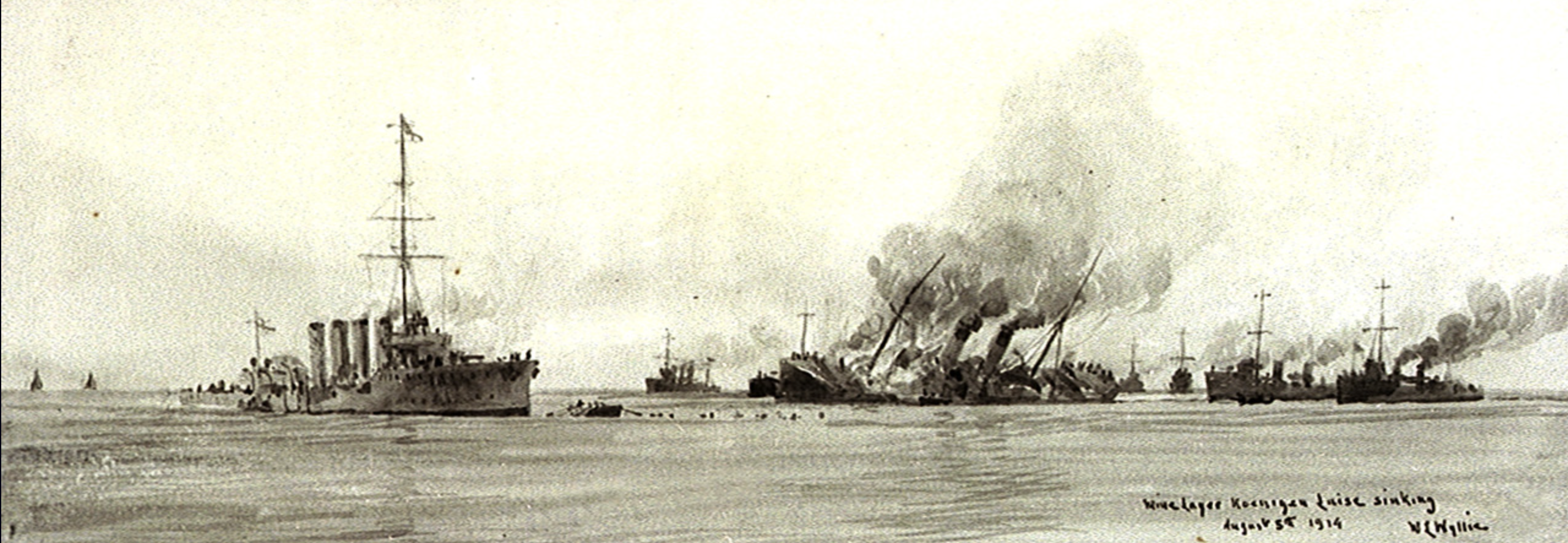
The first German naval loss
By midday the German ship had been badly damaged. With escape no longer realistic, Biermann ordered the crew to abandon ship and the sea-cocks to be opened to hasten her sinking. At about 12:22, Königin Luise rolled over to port and disappeared beneath the North Sea. 1 3
She had been a naval vessel for only two days. Königin Luise consequently became the first German naval vessel lost during the First World War. 1 2
The number of survivors varies between accounts. Royal Museums Greenwich records 43 German sailors rescued by Lance and Landrail, while other accounts give 46 survivors from a crew of roughly 100. The variation is worth retaining rather than forcing the surviving records into a single figure. 1 2
The mines remained
Destroying the minelayer did not remove the danger she had created. The British flotilla continued its patrol before turning back towards Harwich. Captain Fox knew that mines had been laid and attempted to steer clear of the suspected field, but the precise position and extent of the barrier were not known. 1
Shortly before 7am on 6 August, HMS Amphion struck one of Königin Luise's mines. The explosion caused severe damage forward and started a major fire. Attempts were made to abandon and save the cruiser, but she subsequently drifted onto another mine. A second explosion was followed by the detonation of her forward magazine and the ship sank. 1 4
Amphion became the first Royal Navy ship lost in the First World War. The exact casualty totals differ slightly between sources, but around 130 to 150 British sailors were killed, together with a number of the German prisoners rescued from Königin Luise. Winston Churchill informed the House of Commons on 7 August that nearly 130 of Amphion's men had been killed outright and that twenty German prisoners had also been lost. 2 4
The sequence is unusually compressed. On 4 August Königin Luise left Emden to lay mines. On 5 August she became the first German naval vessel sunk in the war. On 6 August the minefield she had laid sank Amphion, the first British naval vessel lost.
The wreck
Published historical sources place the wreck at approximately 51°52′N, 02°30′E in the southern North Sea. The position is consistent with accounts placing the action around 30 nautical miles off Southwold, although individual published positions vary slightly. 1 2 3
The importance of the site lies as much in its historical context as in the original vessel. Königin Luise began life as a modern civilian passenger ship and was converted into a naval auxiliary almost overnight. Unlike purpose-built warships that spent years in active service, there was scarcely any interval between her civilian career and her destruction.
Wreck: SS Königin Luise
Position: approximately 51° 52′ N, 02° 30′ E
Length: approximately 94 metres
Beam: approximately 12.2 metres
Draught: approximately 3.3 metres
Lost: 5 August 1914
Cause: sunk by British destroyers during a minelaying operation
Historical significance: first German naval vessel lost in the First World War
A very short war
It is tempting to treat the story of Königin Luise simply as the first small naval action of a much larger war, but the episode contains several themes that would become characteristic of the conflict at sea. Civilian vessels were rapidly requisitioned and adapted for military use; mines proved capable of destroying warships far more powerful than the vessel that had laid them; and the distinction between merchant technology and naval warfare narrowed almost immediately.
The ship's appearance also illustrates that ambiguity. Königin Luise had been built to carry civilian passengers and was deliberately disguised to resemble another ferry when she entered British waters. Only the mines aboard her and the small guns added during her hurried conversion distinguished the former excursion vessel from the commercial traffic with which she had previously shared the North Sea.
Her operational career nevertheless lasted little more than a day. The minefield survived her and produced consequences far greater than the loss of the minelayer herself. The sinking of Amphion on the following morning meant that the first naval losses suffered by both Germany and Britain in the First World War were directly connected to the same brief operation.
The wreck off the East Anglian coast is consequently the remains of a ship whose transformation from ferry to warship was almost instantaneous. Launched in May 1913, requisitioned in August 1914 and sunk two days later, Königin Luise provides an unusually concentrated archaeological record of the moment the civilian North Sea became a theatre of war.
Explore the wreck
Open SS Königin Luise directly on the Wrecksite map to view the wreck in the southern North Sea and the surrounding bathymetry.
Zoom to SS Königin LuiseSources and further reading
- Wikipedia, “SS Königin Luise (1913)” . Used as a secondary source for construction, dimensions, conversion to an auxiliary minelayer, the minelaying operation and the sinking of HMS Amphion.
- Royal Museums Greenwich, The sinking of the German minelayer 'Königin Luise', 5 August 1914 , William Lionel Wyllie. Used for the contemporary depiction of the action and Royal Museums Greenwich's account of the ships involved, survivors and subsequent loss of HMS Amphion.
- German Naval History, Königin Louise — Hilfsminenleger . Used for dimensions, machinery, armament, mine capacity and the recorded wreck position.
- UK Parliament, Hansard, His Majesty's Ship “Amphion” Sunk By A Mine, 7 August 1914 . Contemporary parliamentary statement by Winston Churchill concerning the loss of Amphion and the German prisoners aboard her.