SS Folia
Three names, three owners and ten years of Atlantic service before a final voyage to the south coast of Ireland.
Around seven kilometres south of Ram Head on the Waterford coast lies the wreck of SS Folia, a large steamship whose ten-year career encompassed Italian emigrant traffic, Canadian ownership, Cunard service and finally the increasingly dangerous Atlantic trade of the First World War. Today she is badly broken in approximately 33 metres of water, although her bow, boilers and stern remain identifiable in INFOMAR survey data.1
Principe di Piemonte
Folia had already lived several quite distinct lives before acquiring the name by which the wreck is now known. She was built at Sunderland by Sir James Laing & Sons for the Italian Lloyd Sabaudo Line and launched in February 1907 as Principe di Piemonte. At approximately 131 metres long and 16 metres in beam, she was a substantial twin-screw liner of around 6,705 gross register tons, powered by two triple-expansion steam engines and capable of about 14 knots. As built, accommodation was provided for 120 first-class, 50 second-class and around 1,500 steerage passengers. 1 2
The ship was one of three closely related liners built for Lloyd Sabaudo's North Atlantic service, alongside Re d'Italia and Regina d'Italia. Her normal route connected Genoa with New York by way of Naples and Palermo, placing Principe di Piemonte firmly within the enormous movement of passengers between southern Europe and North America during the years immediately before the First World War.1 2
Her early career was not without incident. In July 1912 a steam pipe associated with one of the boilers burst during a voyage to New York, killing five members of the engineering and stokehold crew. She nevertheless remained in Lloyd Sabaudo service until the end of 1913, completing her final voyage under Italian ownership that December. 2
Principello
The ship changed hands shortly afterwards and was renamed Principello. Sources differ slightly over the precise sequence of ownership and operation during this period, but she entered Canadian interests and was associated with the Uranium Steamship Company. Initially she worked between Rotterdam and New York, with Halifax included in the service, before moving onto the Avonmouth–New York route in 1915. 1 2 3
These changes coincided with a much larger transformation in the North Atlantic. The outbreak of war in 1914 turned the commercial shipping routes on which Principello had spent her career into an increasingly contested maritime space. Merchant shipping remained fundamental to Britain's supply network while German submarines progressively extended their operations into the Western Approaches and around the Irish coast.
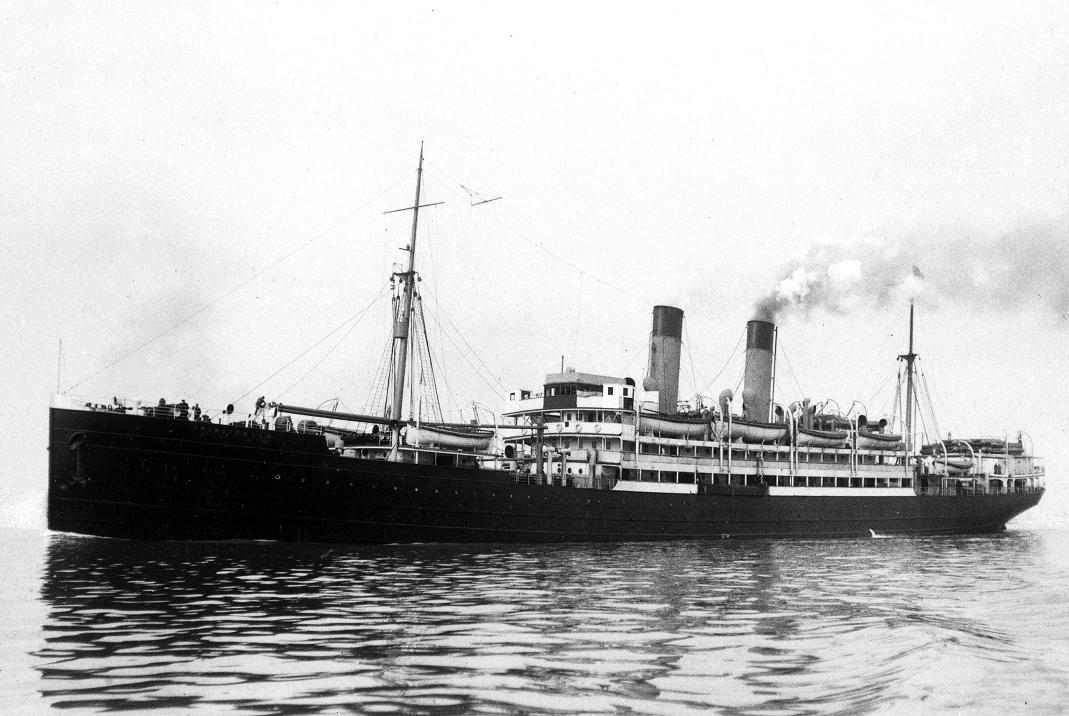
Folia
In 1916 the ship was acquired by Cunard, partly as a replacement for tonnage already lost during the war, and received her third and final name: Folia. Her role had by this point changed substantially from that for which she had been built. Rather than carrying large numbers of Atlantic passengers, she was employed principally as a cargo vessel. INFOMAR records her operating between Liverpool and New York, while other histories give the continuing Avonmouth–New York service.1 2 3
Folia was also defensively armed. Merchant ships operating through waters threatened by U-boats were increasingly equipped with guns, reflecting the increasingly blurred distinction between ordinary commercial shipping and the wartime transport system upon which Britain depended. 2
11 March 1917
Folia's final voyage was from New York towards the Bristol Channel under Captain Francis James Daniel Inch. She was carrying approximately 4,400 tons of general cargo, including trench-digging machinery and shell cases. Inch himself already had considerable experience of maritime disaster: he had commanded Volturno when that vessel was destroyed by fire in the North Atlantic in 1913. 2
At about 07:15 on the morning of 11 March, Folia was roughly four nautical miles east-south-east of Ram Head. Her third officer sighted the periscope of a submarine at a distance of only about 150 metres, followed almost immediately by the tracks of two approaching torpedoes. At such short range there was little opportunity for the liner to alter course. 2
One torpedo struck amidships. The explosion destroyed two lifeboats and killed seven members of the crew, including the second officer. With the ship settling, Inch ordered the surviving crew into the remaining four boats and Folia was abandoned.2
The attacking submarine was the German U-53. Once the evacuation was complete, the submarine surfaced and continued the attack on the disabled ship. Accounts describe four shells being fired into Folia, followed by a further torpedo. INFOMAR summarises the loss as a torpedo attack followed by gunfire; the secondary accounts provide the additional detail of the attack after abandonment. 1 2
Inch gathered the surviving boats together and made for the Waterford coast. They reached shore at around 11am, where people from the Ardmore area assisted the survivors before they were taken onwards to Dungarvan and provided with food, clothing and accommodation. The loss consequently became part of the local history of Ardmore as well as part of the wider submarine campaign being fought around Ireland. 2 4
Seven men were killed in the sinking. There is a discrepancy in the published survivor figures: the INFOMAR wreck sheet records 68 survivors, while a later secondary account gives 78. The figure of seven fatalities, however, is consistent between the principal sources.1 2
The wreck
INFOMAR places the wreck approximately seven kilometres south of Ram Head at 51°52′51.82″N, 07°41′20.77″W, in a general water depth of around 33 metres. The wreck lies almost east–west and is described as badly broken up. 1
It is therefore no longer the recognisable outline of a 131-metre liner resting intact on the seabed. A number of substantial features nevertheless survive. INFOMAR identifies the bow, boilers and stern among the principal high points, with the rudder surviving towards the stern. The modern bathymetric survey records these surviving structures together with the surrounding wreckage as a broad and irregular seabed feature.1
Diving accounts provide a similar description. The bow is among the most intact and readily identifiable sections of the wreck, while the boilers remain prominent amidships. Large quantities of steel plate are scattered around the site and parts of the wreck stand as much as five metres above the surrounding seabed. Damage is particularly extensive aft of the boilers, where much of the former superstructure has disappeared.3
Wreck: SS Folia
Position: 51° 52′ 51.82″ N, 07° 41′ 20.77″ W
Length: approximately 132 metres
Beam: approximately 16 metres
Water depth: approximately 33 metres
Lost: 11 March 1917
Cause: torpedoed by U-53
Lives lost: 7
Salvage and survival
The present condition of Folia cannot be attributed solely to the circumstances of her sinking and a century of deterioration underwater. The wreck has also been subject to substantial salvage. A commercial operation during the 1970s recovered quantities of brass from the site, and further material was subsequently removed by local divers. The disturbance associated with this work is particularly apparent in the after part of the wreck.2 3
Propeller blades, bells and other fittings have been recovered over the years. One of the bells retained the ship's original name, Principe di Piemonte, while another carried the later name Folia. The survival of both is an unusually direct reminder of the changes of ownership and identity that characterised the ship's short career. 3
The ship's gun also remained associated with the wreck long after the sinking. It was eventually recovered and is now displayed at Ardmore, bringing an object from the wreck back to the community which received the survivors in March 1917. 3
Three ships in one wreck
The history represented by the wreck extends well beyond Folia's brief period under Cunard ownership. The ship was conceived for a very different Atlantic: as Principe di Piemonte she belonged to the large-scale passenger and emigrant traffic linking Italy and the United States before 1914. As Principello, she passed into Canadian ownership and continued to work the North Atlantic. As Folia, the same hull became part of the wartime cargo system and was defensively armed against the submarine threat.1 2
The archaeological site south of Ram Head is consequently the end point of all three careers. The wreck itself is dispersed, but the surviving bow, boilers, stern structure and extensive debris field can still be related to the scale of the original liner. INFOMAR's survey is particularly useful here because it records the site as it now exists rather than attempting to impose the original ship's profile upon it. 1
More than a century after the sinking, Folia is also an archaeological site rather than simply a diving attraction. INFOMAR notes that wrecks more than 100 years old and archaeological objects found underwater are protected under Irish legislation, and that a licence is required to dive the site.1
What remains on the seabed is therefore a fairly untidy record of a remarkably compressed period of maritime history: a ship built for mass passenger transport between Europe and America, transferred twice as the commercial and political situation changed, and finally lost carrying wartime cargo through the Western Approaches. Ten years separate her launch at Sunderland from her sinking off Waterford.
Explore the wreck
Open SS Folia directly on the Wrecksite Ireland map to view the wreck south of Ram Head and the surrounding INFOMAR bathymetry.
Zoom to SS FoliaSources and further reading
- Geological Survey Ireland / INFOMAR, SS Folia — INFOMAR Wreck Information Sheet . Primary source for the wreck position, survey imagery, dimensions, wreck condition and INFOMAR's account of the sinking.
- Wikipedia, “SS Folia” . Used as a secondary source for construction, ownership, passenger capacity, final cargo and the chronology of the attack and evacuation.
- Sam Warwick and Mike Roussel, Shipwrecks of the Cunard Line — Folia . Used for additional information concerning the surviving wreck, salvage and recovered artefacts.
- Ardmore Waterford, Ardmore — Where Two Worlds Collided . Used for the local historical account of the sinking and its connection with Ardmore.