RMS Leinster
A routine mail crossing from Dublin to Holyhead, interrupted by a U-boat with the First World War almost over.
There was nothing exceptional about Leinster's route. She was one of the mailboats running between Kingstown — now Dún Laoghaire — and Holyhead, part of a service which had connected Ireland and Wales for decades.
The crossing could be completed in around two and a half hours. Mail was sorted aboard, passengers came and went, soldiers used the route, and crews were drawn from communities on both sides of the Irish Sea.
It was infrastructure more than adventure: ordinary, dependable and familiar.
On 10 October 1918, that ordinary crossing became one of the greatest maritime disasters in the history of the Irish Sea.
The mailboat
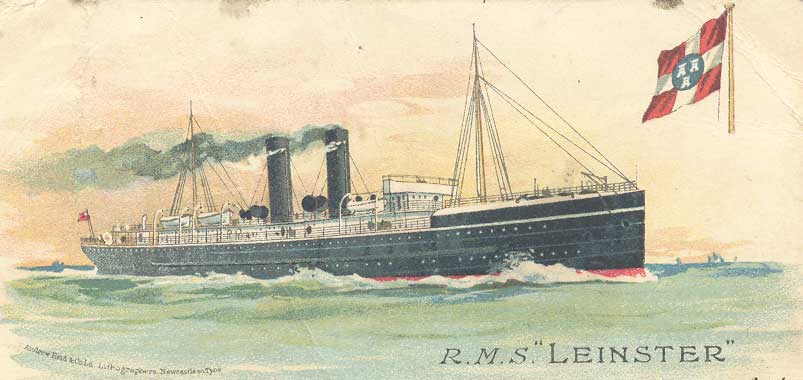
RMS Leinster belonged to the City of Dublin Steam Packet Company, one of a small fleet maintaining the mail service between Kingstown and Holyhead.
The route had been in regular use since 1848 and the company's vessels were more than simple passenger steamers. They functioned as travelling extensions of the postal service, with sorting clerks processing mail while the ships crossed the Irish Sea.
Their crews were closely connected with the ports at either end of the route. Kingstown and Holyhead were not simply destinations on a timetable; their communities were bound together by the ships which continually crossed between them.
During the First World War that ordinary traffic continued. Civilians and mail shared the vessels with soldiers and other military personnel moving between Britain and Ireland.
10 October 1918
Leinster left Kingstown on the morning of 10 October 1918. The weather in port was fine, although the Irish Sea remained unsettled after earlier storms and a rough crossing was expected.
Under normal conditions Holyhead was little more than two and a half hours away.
She never got close.
Around an hour after leaving Kingstown, with the ship still not clear of Dublin Bay, Leinster encountered the German submarine SM UB-123.
The U-boat torpedoed the mailboat.
Leinster had become one of the final major victims of the German submarine campaign. The timing was particularly cruel. The First World War had only weeks left to run.
A short journey becomes a disaster
There were 771 people aboard Leinster.
Current research places the number killed at 569, making the sinking the greatest single loss of life recorded in the Irish Sea.
The scale of the disaster is difficult to reconcile with the nature of the voyage. Many of those aboard had expected to be stepping ashore in Wales later that morning. Instead the ship had been destroyed within sight of the Irish coast.
Rescue vessels immediately headed out from Kingstown. Survivors were brought back to Dublin, where hotels and other buildings were used to receive them.
But the consequences of the sinking continued long afterwards. Bodies were recovered from the sea and washed ashore for weeks, not only around Ireland but on the opposite side of the Irish Sea in Wales.
A disaster shared across the Irish Sea
That geography matters.
Leinster was not an isolated warship operating far offshore. She belonged to an everyday route connecting two communities. Mail clerks, passengers, sailors and soldiers continually moved between Kingstown and Holyhead aboard the same small group of ships.
When Leinster sank, the shock therefore spread naturally across both coasts.
The City of Dublin Steam Packet Company had already lost another of its vessels, RMS Connaught, during the war. The company never recovered from the losses it sustained and eventually ceased trading in 1922.
The wreck today
More than a century later, Leinster remains on the seabed off Dublin.
The wreck has been mapped in detail as part of a collaborative survey involving INFOMAR and Ulster University, allowing the surviving hull to be viewed not simply as a point on a chart but as a three-dimensional archaeological site.
As with many wrecks of the First World War, time has also changed the site biologically. A large steel hull on the seabed provides hard structure in an environment where such surfaces may otherwise be scarce.
Shoals of fish gather around wrecks such as Leinster, while wrasse and conger eels occupy openings in the structure and anemones attach themselves to the surviving hull.
The ship has therefore acquired a second existence. What began as part of the transport infrastructure of the Irish Sea became first a wartime wreck and then, slowly, an artificial reef.
A difficult wreck
Leinster is still visited by experienced divers, but it is not an easy site.
Strong tidal currents and poor visibility can make navigation difficult, while the wreck's position beneath modern passenger ferry routes adds another hazard to diving the site.
The wreck is consequently very different from the ship that once made a routine crossing between Ireland and Wales several times a week. Modern ferries continue to cross the same sea above it, following a connection which has outlived Leinster herself.
The ordinary made extraordinary
There is a temptation with famous shipwrecks to concentrate entirely on the moment the ship disappeared. With Leinster, that misses something important.
The tragedy was powerful precisely because the voyage was so ordinary.
This was a mailboat leaving Dublin for Holyhead on a route which had been travelled thousands of times before. Its passengers were not beginning an ocean voyage or sailing into battle. Most expected a short crossing and an arrival later that morning.
Instead, a piece of everyday infrastructure became one of the final major maritime casualties of the First World War. More than a century later, the same waters are still crossed every day between Ireland and Britain.
Leinster remains beneath them.
Survey and further reading
RMS Leinster has been surveyed as part of a collaborative project involving INFOMAR and Ulster University. INFOMAR maintains survey imagery and a three-dimensional model of the wreck as part of its Irish shipwreck dataset.
Explore the wreck
Open RMS Leinster directly on the Ireland wreck map and explore the surrounding seabed.
Zoom to RMS Leinster