SMS Kronprinz Wilhelm
A battleship which survived Jutland, a British submarine torpedo and collision with one of her own sister ships, only to be sunk deliberately by her own crew.
On the afternoon of 21 June 1919, the German battleship Kronprinz Wilhelm disappeared beneath the waters of Scapa Flow. There was no battle and no enemy fleet. Her own crew had opened the seacocks and deliberately sunk her.
It was a strangely quiet ending for a ship built for a very different kind of war. During the previous five years she had served with the Imperial German Navy's High Seas Fleet, fought at Jutland, been torpedoed by a British submarine, rammed by another German battleship and taken part in the invasion of the Baltic islands during Operation Albion.
More than a century later much of that battleship still lies where she sank. Turned almost completely upside down and partly buried in the seabed, Kronprinz Wilhelm is now one of the great wrecks of Scapa Flow.
A battleship for the North Sea
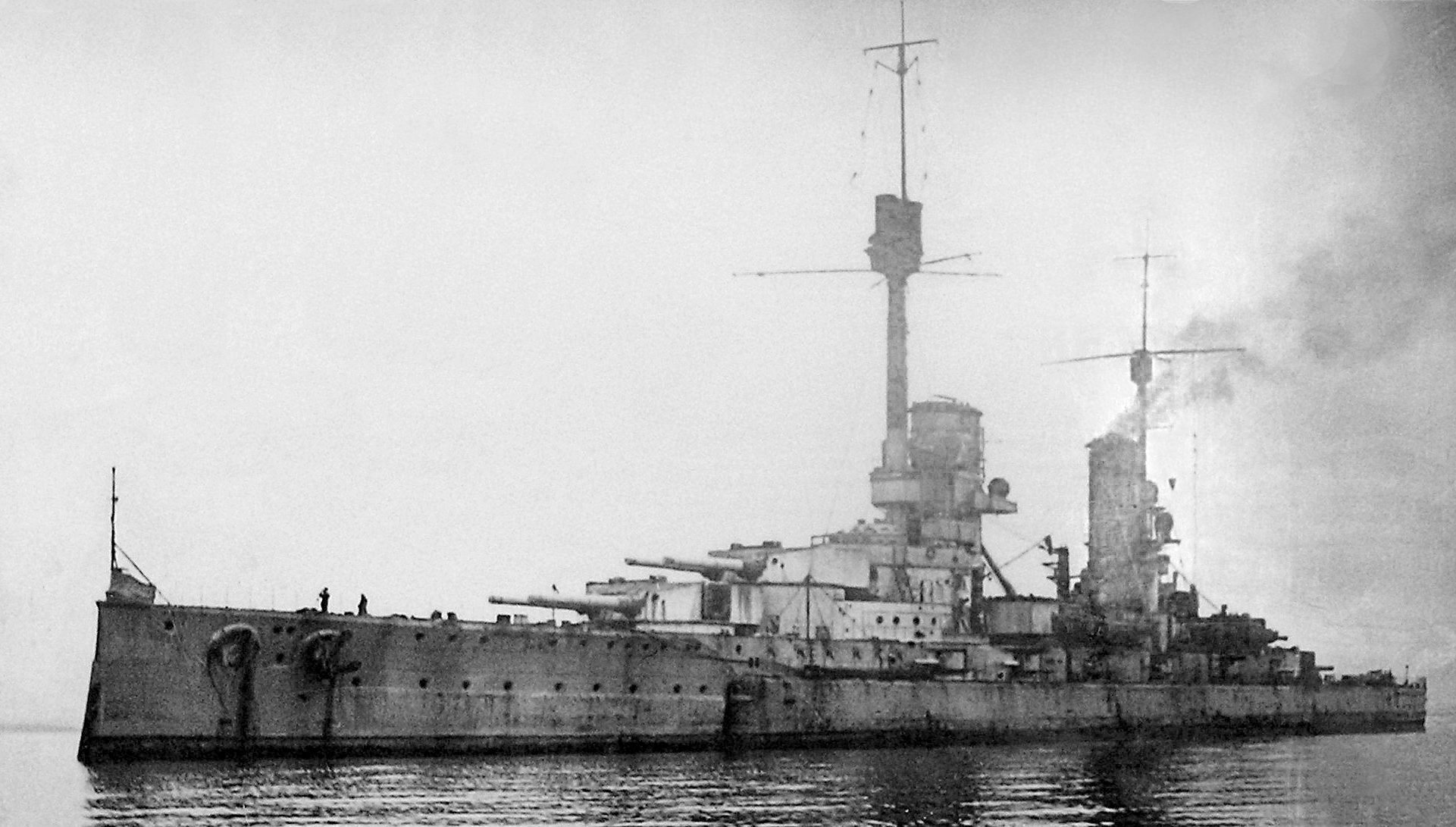
Kronprinz was the last of four König-class battleships, built as Germany and Britain continued the naval arms race which preceded the First World War. She was constructed at the Germaniawerft yard in Kiel, launched on 21 February 1914 and commissioned that August, just as Europe went to war.1
The König class represented a refinement of Germany's earlier dreadnought battleships. Their main battery consisted of ten 30.5 cm guns mounted in five twin turrets, all positioned on the centreline. Fourteen 15 cm guns formed the secondary battery, mounted in casemates along the sides of the ship.3
Protection was formidable. The lower armour belt reached 350 mm, the sides of the main gun turrets 300 mm and the forward control tower was similarly protected by 300 mm of armour. Propulsion came from three sets of Parsons turbines driving three propellers, giving a maximum speed of about 21 knots.3
These were not fast battlecruisers. They were heavily armed, heavily protected ships intended to stand in the German battle line and exchange fire with the battleships of the Royal Navy.
Jutland
By 1916 Kronprinz formed part of the III Battle Squadron of the High Seas Fleet. She took part in the German advance towards Terschelling in March and supported the battlecruiser raid against Lowestoft and Great Yarmouth the following month. Neither operation produced the decisive encounter with the British Grand Fleet that German naval planners hoped for.3
That encounter finally came on 31 May 1916.
At the Battle of Jutland the German High Seas Fleet and British Grand Fleet met in what became the largest clash of battleships in history. Kronprinz sailed with the German battle line and was heavily engaged during the confused fighting of the afternoon and evening.
Remarkably, she emerged from the battle without being hit and without suffering any casualties.3 Other ships were considerably less fortunate. Jutland cost both fleets thousands of men and several major warships, but failed to produce the decisive victory either side had sought.
A torpedo from HMS J1
Kronprinz's luck did not last.
On 4 November 1916 she was returning from an operation connected with the recovery of the German submarines U-20 and U-30 when the British submarine HMS J1 attacked the German force. A torpedo struck Kronprinz and damaged the battleship sufficiently to require approximately a month of repairs at Wilhelmshaven.3
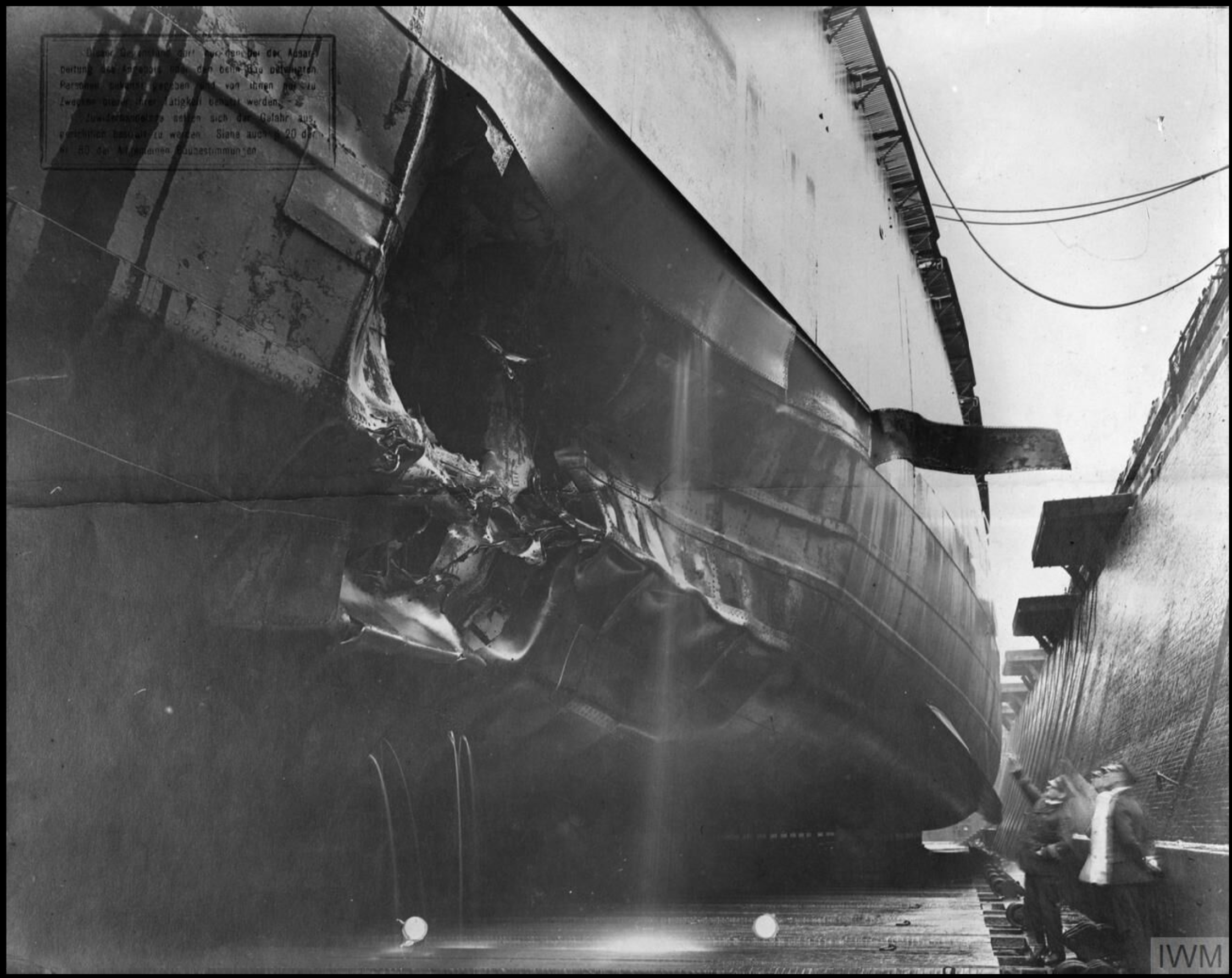
Only a few months later she was damaged again, this time without British assistance. On 5 March 1917 the battleship Grosser Kurfürst, another member of the König class, rammed Kronprinz while the ships were manoeuvring in the Heligoland Bight.
Around 600 tonnes of water entered the ship. She returned once again to Wilhelmshaven and remained under repair until May.3
Operation Albion
The following October brought Kronprinz into a very different theatre of war. During Operation Albion the German navy supported the invasion of the Russian-held Baltic islands of Saaremaa, Hiiumaa and Muhu.
Here Kronprinz fought another battleship, the Russian pre-dreadnought Grazhdanin. She scored two hits on the Russian vessel while remaining undamaged herself.3
It would prove to be one of the last significant operations of the Imperial German battle fleet.
Kronprinz becomes Kronprinz Wilhelm
On 15 June 1918 the ship was renamed Kronprinz Wilhelm. By then the strategic situation facing Germany had changed completely. The High Seas Fleet remained a powerful force, but the Royal Navy's blockade and overwhelming numerical superiority meant that another fleet action offered little prospect of changing the course of the war.
Germany requested an armistice in November 1918.
Under its terms the most modern ships of the High Seas Fleet were to be interned while the Allies decided what should happen to them. On 19 November Kronprinz Wilhelm left Germany for the last time.3
The fleet at Scapa Flow
Eventually 74 German warships were assembled at Scapa Flow: battleships, battlecruisers, cruisers and destroyers sitting at anchor under the supervision of the Royal Navy.
Their crews remained aboard, but in greatly reduced numbers. Months passed. The ships deteriorated and morale declined while negotiations over the Treaty of Versailles continued.
Rear Admiral Ludwig von Reuter, commanding the interned fleet, became convinced that the ships were about to be seized. Rather than allow the High Seas Fleet to be divided amongst Germany's former enemies, he decided to destroy it.
21 June 1919
On the morning of 21 June most of the British guard force left Scapa Flow for exercises. It was the opportunity von Reuter had been waiting for.
Shortly before midday signals passed between the German ships. Seacocks were opened, internal pipes smashed and watertight doors deliberately left open. German flags appeared on ships which had spent months at anchor.
Then the High Seas Fleet began to sink.
British vessels rushed back into the Flow and attempted to beach as many ships as possible, sometimes towing or pushing them into shallow water. Armed guards attempted to force German crews back aboard their ships.
Kronprinz Wilhelm could not be saved.
At approximately 13:15 the battleship rolled over and disappeared beneath the surface.3
The scuttling was not entirely bloodless. Karl Bauer, a stoker from Kronprinz Wilhelm, was seriously wounded by gunfire from British drifters during attempts to prevent the sinking and subsequently died. He is buried in the naval cemetery at Lyness on Hoy.3
By the end of the day more than fifty German warships lay on the bottom of Scapa Flow.
The great salvage operation
The destruction of the High Seas Fleet created one of the strangest industrial landscapes ever to exist beneath the sea. Battleships and battlecruisers weighing tens of thousands of tonnes lay upside down in comparatively sheltered water.
During the following decades many were raised.
The salvage operations associated particularly with Ernest Cox became engineering feats in their own right. Destroyers were lifted, larger vessels were patched and pumped full of air, and eventually even battlecruisers and battleships were brought back to the surface and towed away for scrap.
Kronprinz Wilhelm, however, remained.
Salvage still changed the wreck considerably. Valuable non-ferrous metals and machinery were removed and sections of hull were opened to reach the engineering spaces. The ScapaMAP survey records extensive salvage around the engine compartments of the surviving battleships.2
Objects have continued to emerge from the history of the wreck. Material recorded through the Receiver of Wreck amnesty included a steam gauge, boiler plate, lamps, electrical equipment, brass fittings, a voice pipe and a German Imperial Navy nameplate marked Linker Aufzug.3
The wreck today
What remains on the seabed is not a neat battleship lying on its keel. Kronprinz Wilhelm lies almost completely upside down, her superstructure driven into the seabed. The hull has broken forward of the forward gun turret and the bow has settled separately onto the seabed.2
Despite this, substantial parts of the battleship survive. Casemate guns and parts of the main armament can still be seen, while openings created by collapse and historic salvage provide glimpses into the enormous inverted hull.
The wreck is not static.
Divers interviewed during the ScapaMAP work reported that routes through the structure which had previously been accessible had closed while new openings had appeared. The report interpreted this as evidence of settlement of the hull as a whole.2
Corrosion is visible as both loss of plate material and separation along riveted joints. Encrusting marine growth can offer the underlying steel some protection, but where it is removed the metal is exposed once again.
The result is a wreck which is still changing, even after more than a century on the seabed.
Seeing a battleship
ScapaMAP surveyed the German wrecks in 2001 and returned in 2006 with improved high-resolution multibeam equipment. The project was interested not simply in locating the wrecks, but in whether repeated remote surveys could be used to monitor their condition over time.2
For a wreck such as Kronprinz Wilhelm, this matters. A conventional depth surface struggles with overhangs, vertical hull sides and the extraordinary geometry of an inverted battleship.
The ScapaMAP team found that point-cloud visualisation was often more useful than forcing the measurements into a continuous surface. In an interactive display, movement supplies the depth cues that a flat image cannot.2
The point cloud below comes from the WreckSight visualisation of Kronprinz Wilhelm.4 It is not a reconstruction of the battleship and it does not attempt to fill the gaps. Each visible point represents part of the measured underwater geometry.
Seen together, they produce the ghost of a 25,000-tonne warship on the seabed.
Explore SMS Kronprinz Wilhelm in 3D
Drag to rotate the survey, scroll to zoom and right-drag to move across the wreck. The model is intentionally rendered as a point cloud rather than a fabricated solid surface.
There is something particularly effective about seeing the wreck this way. From directly above it can be difficult to make sense of the collapsed hull. Once the survey is rotated, the surviving height of the structure, the displaced bow and the enormous scale of the site become much easier to read.
The ScapaMAP report reached much the same conclusion nearly twenty years ago: for complex wrecks, interactive point clouds can communicate shape better than a conventional gridded surface.2
Explore the wreck
Open SMS Kronprinz Wilhelm on the Wrecksite map and explore the surrounding waters of Scapa Flow.
Zoom to Kronprinz WilhelmSources and further reading
- “SMS Kronprinz (1914)” , Wikipedia. Used as a secondary overview of the ship's design and operational history; the article itself cites Gröner, Staff, Campbell, Tarrant, Herwig and other published naval histories.
- SULA Diving, ScapaMAP2: Marine Heritage Monitoring with High-Resolution Survey Tools — Scapa Flow 2001–2006, Final Report . Historic Scotland. Used for wreck condition, survey methodology, 2001/2006 point-cloud interpretation, deterioration and diving activity.
- SMS Kronprinz Wilhelm Wreck — Scapa Flow , wreck factsheet. Used for ship particulars, service chronology, Karl Bauer, artefacts and photographic references.
- WreckSight — SMS Kronprinz Wilhelm . Original online point-cloud visualisation and source data used for the interactive 3D wreck model on this page.