HMS Vanguard
The Victorian ironclad lost after a collision with HMS Iron Duke off the coast of County Wicklow in 1875.
On 1 September 1875, HMS Vanguard left Kingstown with a squadron of Royal Navy ironclads bound south for Queenstown. Thick fog developed as the ships proceeded down the Irish coast. A few hours later Vanguard had been rammed by her sister ship HMS Iron Duke and was sinking off County Wicklow.
The loss was a serious embarrassment for the Royal Navy. Vanguard was a relatively new armoured warship, yet the damage caused by a collision below the waterline proved fatal. More remarkably, the entire ship's company was evacuated before she sank.
A Victorian ironclad
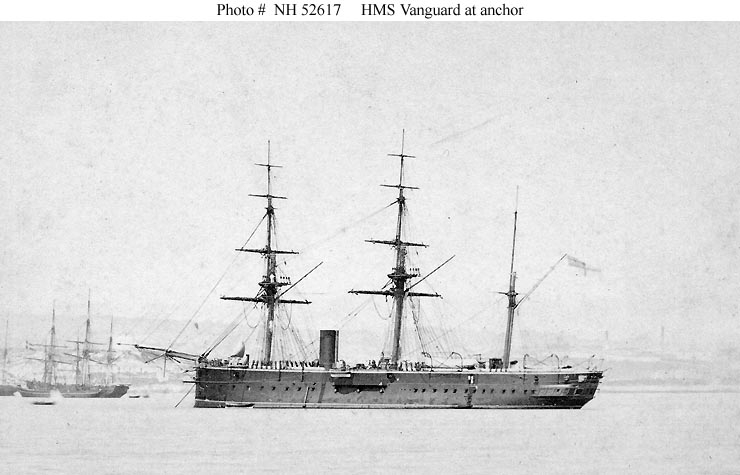
HMS Vanguard was an Audacious-class ironclad launched in 1870 from the Laird shipyard at Birkenhead. The class belonged to a transitional period in naval design, when warships still carried masts and sails but increasingly relied on steam machinery, armour and heavy rifled guns.
Vanguard was built with an iron hull and protected by armour around the central battery and waterline. Steam engines drove a single screw propeller, although a full sailing rig was retained. Like many ironclads of the period, she was also fitted with a reinforced ram bow intended to be used against enemy ships at close range.
During the early 1870s Vanguard served as guardship at Kingstown, now Dún Laoghaire. Her loss therefore occurred in waters with which the ship and her crew were familiar.
1 September 1875
Vanguard sailed from Kingstown as part of the Reserve Squadron, heading south towards Queenstown. HMS Iron Duke followed behind her in the formation. As the squadron passed the Kish area, visibility deteriorated rapidly and the ships entered dense fog.
The squadron reduced speed, but the ships remained relatively close together. Vanguard then altered course to avoid a sailing vessel which had appeared ahead. Iron Duke, following astern and unable to see Vanguard clearly through the fog, did not make the same alteration.
Iron Duke emerged from the fog on a converging course. Despite attempts by both ships to avoid a collision, her bow struck Vanguard on the port side near the engine and boiler spaces.
Damage below the waterline
The collision opened Vanguard's hull below the armour belt and below the waterline. Water entered the engineering spaces rapidly, flooding the compartments and depriving the ship of power.
The damage demonstrated a weakness common to early ironclads. Their armour offered substantial protection against gunfire, but a large opening beneath the armour could still overwhelm the ship's internal subdivision. Vanguard's pumps could not keep pace with the flooding.
Efforts were made to control the inflow and keep the ship afloat, but it soon became clear that Vanguard could not be saved.
The evacuation
There was enough time to evacuate the ship. Boats were lowered from Vanguard and Iron Duke and the crew transferred away from the sinking ironclad.
More than 300 men were aboard Vanguard, yet no human lives were lost. Captain Richard Dawkins remained aboard until the evacuation had been completed.
Vanguard continued to settle as the flooding spread through the hull. She eventually sank in approximately 45 metres of water off the County Wicklow coast.
The inquiry
The loss of a modern warship in peacetime inevitably resulted in a formal investigation. The subsequent court martial examined the speed and spacing of the squadron, the handling of Vanguard before the collision and the signalling arrangements between the ships.
The accident was not attributed to a single mechanical failure. Instead, a combination of restricted visibility, close formation, changes of course and insufficient communication placed the two ships on intersecting courses.
The incident also added to growing doubts about the usefulness of ram bows. Although intended primarily as offensive weapons, rams were involved in several serious collisions between friendly ships during the ironclad era.
The wreck
HMS Vanguard remains on the seabed off County Wicklow. Modern INFOMAR surveys have recorded the wreck in detail, allowing the surviving structure to be examined from high-resolution bathymetric data.
The ship's lighter upper structures, masts and funnels have long since disappeared or collapsed, but substantial parts of the iron hull survive. The wreck still reflects the broad proportions of a nineteenth-century ironclad and provides a rare archaeological example of a type of warship that existed only briefly during the rapid development of naval technology in the second half of the nineteenth century.
Vanguard is also unusual because the circumstances of her loss are unusually well documented. The wreck can be compared directly with contemporary descriptions of the collision, the flooding and the subsequent inquiry.
A short career
Vanguard had been in service for only a few years when she sank. She never experienced the combat for which she had been designed and was instead lost during an ordinary squadron passage along the Irish coast.
The collision nevertheless illustrates the problems faced by navies during the early ironclad period. Ships had become heavier, faster and more powerful, while signalling, manoeuvring and damage-control practices were still adapting to the new technology.
Today the remains off Wicklow record that period of experimentation rather more clearly than Vanguard's short operational career ever had the chance to.
Survey and further reading
HMS Vanguard is included in INFOMAR's Irish shipwreck dataset, which records wrecks identified and surveyed during the Irish National Seabed Survey and INFOMAR programmes.
Explore the wreck
Open HMS Vanguard directly on the Ireland wreck map and explore the surrounding seabed.
Zoom to HMS Vanguard