HMS Prince Leopold
The history, wartime service and wreck site of HMS Prince Leopold.
HMS Prince Leopold had a varied operational history before becoming one of the many wartime vessels now resting beneath UK waters. This page explores the vessel’s origins, service, loss and present-day wreck site.
History of HMS Prince Leopold
TS Prince Leopold was launched in November 1929 by John Cockerill SA at Hoboken, Belgium. Built with a steel hull measuring 105.8 metres in length and 14.1 metres across the beam, she displaced 2,938 gross registered tons. Six steam turbines, fed by six water-tube boilers, drove twin propellers and gave her a respectable top speed of 23.5 knots.
Completed in July 1930 for the Régie voor Maritiem Transport of Ostend, Prince Leopold was designed as a cross-Channel ferry capable of carrying up to 1,400 passengers. Her entry into service was almost delayed indefinitely when a fire broke out in the engine room on 14 July, pushing back her delivery until 30 July.
Just three days later she began regular sailings between Ostend and Dover, a route she would serve for almost a decade. In December 1939 the service was switched from Dover to Folkestone, although the change proved short-lived. When Germany invaded Belgium in May 1940, Prince Leopold crossed to Southampton, where plans were made to convert her into a hospital ship. In the end, that conversion never took place.
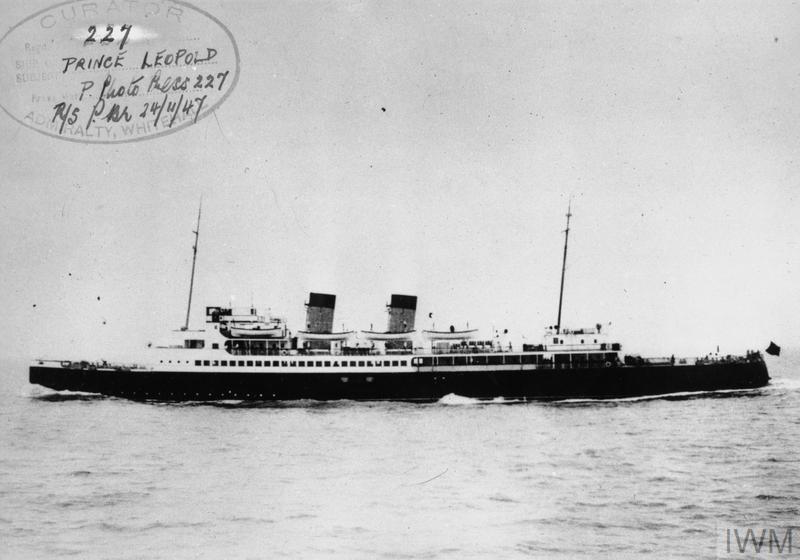
Wartime service
With the evacuation of France underway in June 1940, Prince Leopold was pressed into service helping to evacuate Allied troops and civilians from the ports of St Malo, Cherbourg and Brest. Her civilian career was now effectively over.
On 23 September 1940 she was formally requisitioned by the Admiralty and sent to Devonport for conversion into a Landing Ship Infantry (Small), or LSI(S). By the time the work was completed on 6 March 1941, she had been commissioned as HMS Prince Leopold and allocated the pennant number 4251. The conversion allowed her to carry around 250 troops together with eight landing craft, while a suite of anti-aircraft guns provided protection during amphibious operations.
Over the next four years HMS Prince Leopold took part in some of the most significant Allied amphibious operations of the Second World War. She carried troops during Operation Archery, the raid on Vågsøy in December 1941, before participating in Operation Jubilee, the ill-fated Dieppe Raid, in August 1942. In July 1943 she supported the Allied invasion of Sicily, and less than a year later she was among the ships carrying assault troops to Sword Beach during the Normandy landings on 6 June 1944.
The loss of HMS Prince Leopold
Following the Normandy landings, HMS Prince Leopold continued her relentless work ferrying troops and equipment across the English Channel in support of the Allied advance through France.
That service came to an abrupt end on 29 July 1944. While crossing the Channel, she was struck by a GNAT acoustic homing torpedo fired by the German submarine U-621. The explosion left the ship badly damaged and rapidly developing a heavy list.
The destroyer HMS Chelmer came alongside and attempted to save the vessel by passing over pumps to control the flooding. As Prince Leopold's list increased, however, it became too dangerous for Chelmer to remain alongside and she was forced to cast off. The Dutch tug Amsterdam then took the stricken ship in tow in the hope of bringing her to safety.
Those efforts proved unsuccessful. Before reaching harbour, HMS Prince Leopold rolled over and sank beneath the Channel. The exact number of people on board remains uncertain, but it is believed that more than 200 were aboard at the time of the attack. At least 54 men are known to have lost their lives.
The wreck today
Today, HMS Prince Leopold rests upright on a gravel seabed around 30 metres below the surface, approximately six miles south-east of the Nab Tower off the Isle of Wight. Although decades of salvage and wartime clearance have altered the site, the wreck remains remarkably recognisable.
Divers report that the hull still sits with a pronounced list to starboard, while a large opening in the port side marks the point where the German torpedo is believed to have struck. Little of the superstructure survives above the hull, much of it having been removed during post-war clearance operations, but the bow remains largely intact. During an early dive in 1975, depth charges were still recorded in their racks, a reminder of the ship's final wartime role.
Over the years a number of artefacts have been recovered from the site, including portholes, shell cases, navigational equipment, a brass capstan top and the ship's bell bearing the inscription "PRINCE LEOPOLD, Ostende". The bell has since been returned to Belgium, where it is displayed at the Oostends Historisch Museum De Plate, reconnecting one of the ship's most recognisable features with her port of origin.
Despite the effects of time, salvage and the harsh marine environment, HMS Prince Leopold remains one of the more evocative Second World War wrecks in the English Channel. Resting where she sank in July 1944, the site serves as both a significant archaeological resource and a lasting memorial to the men who lost their lives when the ship was torpedoed.
Further reading
Historic England's Heritage Gateway contains a detailed archaeological record for HMS Prince Leopold, including survey information, recovery records and the history of the wreck site.
Historic England – Heritage Gateway record for HMS Prince Leopold
Explore the wreck location
Open HMS Prince Leopold directly on the Wrecksite map.
Zoom to HMS Prince Leopold